Getting the timing wrong with fertiliser is one of the most common lawn mistakes homeowners make. You apply it too early and the roots don’t absorb it. Too late, and you’ve wasted your money on grass that’s already shutting down for the season. Knowing when to fertilise grass is the difference between a lawn that thrives and one that barely survives.
Here’s the quick answer: fertilise cool-season grasses in early spring and again in autumn (September–October). Fertilise warm-season grasses from late spring (April–May) through early autumn (September). Timing always depends on your grass type, soil temperature, and climate. Keep reading this guide covers all of it.
When to Fertilise Depends on Your Grass Type
Your grass type is the single most important factor in deciding when to feed your lawn. Cool-season grasses and warm-season grasses have completely different growth cycles, and feeding them at the wrong time can actually do more harm than good.
There are two main categories:
- Cool-season grasses These grow most actively in spring and autumn when temperatures sit between 10°C–18°C (50°F–65°F). Common types include ryegrass, tall fescue, fine fescue, Kentucky bluegrass, and bentgrass. They’re most common in the UK, northern US, and similar climates.
- Warm-season grasses thrive in heat and peak growth happens in summer. Common types include bermudagrass, zoysiagrass, St. Augustinegrass, centipedegrass, buffalograss, and bahiagrass. They go dormant and turn brown in winter.
Not sure which you have? A quick way to tell: if your lawn stays green in autumn and early spring but struggles in peak summer heat, it’s likely a cool-season grass. If it greens up in May and goes brown in November, it’s warm-season.
When to Fertilise for a Greener Lawn (Seasonal Breakdown)
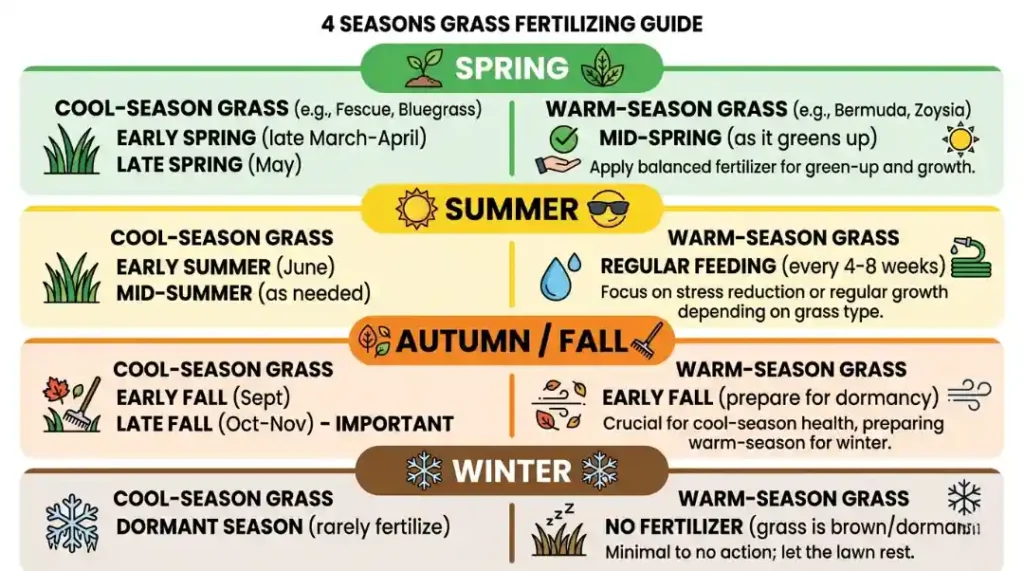
Most lawns need feeding 2–4 times per year. The exact schedule depends on your grass type, but here’s how the seasons break down.
Spring Fertilising (March – May)
For cool-season grasses, spring is the first feeding window of the year. Wait until soil temperatures hit around 10°C (50°F) consistently before applying. Feeding too early — when the ground is still cold wastes product because roots aren’t actively absorbing nutrients yet.
Apply a balanced fertiliser with a slightly higher nitrogen (N) content to push green growth after winter. For warm-season grasses, hold off until late spring (April–May) when soil temperatures have been steady at around 18°C (65°F) for a couple of weeks.
Summer Fertilising (June – August)
Summer is tough on grass. Heat, drought stress, foot traffic, and lawn pests all take their toll. For warm-season grasses, summer is actually the peak feeding window this is when bermudagrass, zoysia, and St. Augustine are actively growing and hungry for nutrients.
For cool-season grasses, mid-summer feeding is generally not recommended. The grass is under heat stress, and pushing nitrogen-heavy growth during this period weakens the root system. If you must feed in summer, use a slow-release fertiliser at a reduced rate.
Autumn Fertilising (September – October)
This is the most important feeding window for cool-season grasses. Roots are still active, air temperatures are cooling, and the grass is storing energy for winter. An autumn application high in potassium (K) and phosphorus (P) strengthens roots and improves winter hardiness.
For warm-season grasses, a light feed in early September helps the lawn recover from summer stress before it goes dormant. Stop feeding 6–8 weeks before your first expected frost.
Winter Should You Fertilise at All?
Short answer: no. Fertilising dormant grass in winter is a waste of product and can stress the lawn. Cool-season grasses slow right down, and warm-season grasses are fully dormant. The only exception is a dedicated winteriser product applied in late autumn (October–November) before the ground freezes.
When and How to Fertilise New Grass
New grass whether seeded or laid as turf needs a different approach to fertilising than an established lawn. Feeding too early or with the wrong product can burn tender new roots or encourage too much top growth before the roots have properly established.
Here’s what to do:
- Seeded lawns: Wait until the grass has been mowed at least 2–3 times before applying any fertilizer. This usually takes 6–8 weeks. Use a starter fertiliser high in phosphorus to support root development.
- Turf/sod: Apply a starter fertiliser 4–6 weeks after laying, once the turf has knitted into the soil. You can check this by gently tugging a corner if it lifts easily, the roots haven’t set yet.
- Avoid high-nitrogen products on new grass. Heavy nitrogen promotes rapid leaf growth while the root system is still too shallow to support it.
When and How to Fertilise Established Lawns
An established lawn has a deeper root system and can handle more. Still, the fundamentals don’t change timing, soil temperature, and grass type all matter.
For established cool-season lawns, stick to this schedule:
- Early spring (March–April) Balanced NPK feed to kick off the growing season
- Early autumn (September) High-potassium feed for root strength
- Late autumn (October–November) Winteriser to close out the season
For established warm-season lawns:
- Late spring (April–May) First feed as the lawn exits dormancy
- Early summer (June) Peak growing season feed
- Early autumn (September) Light feed before dormancy
Signs Your Grass Needs Fertilising Now
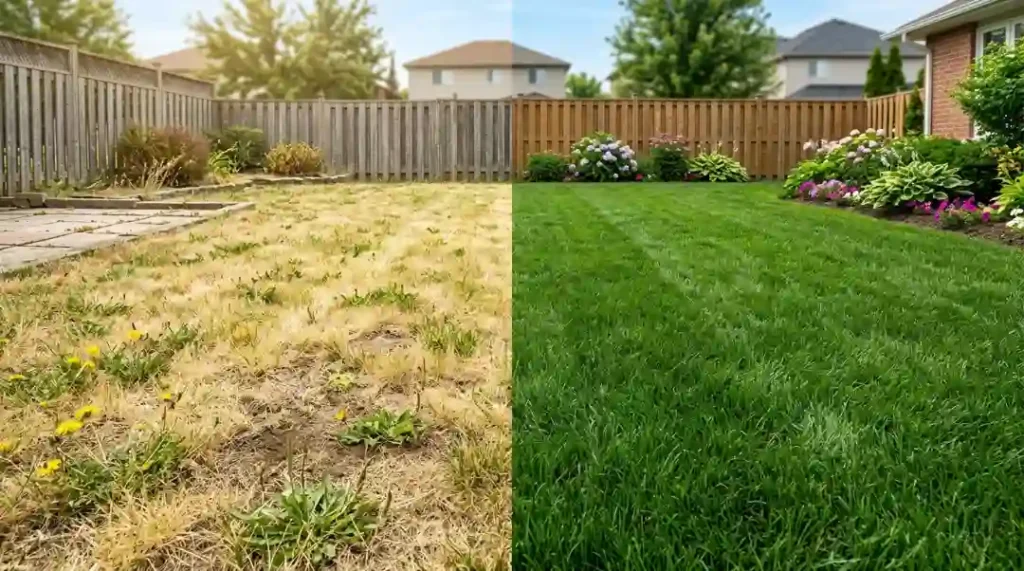
Sometimes the lawn tells you before the calendar does. Watch for these signals:
- Pale or yellowing grass Often a sign of nitrogen deficiency
- Slow growth after mowing Grass taking longer than usual to recover
- Thin, patchy areas Especially in high-traffic zones
- Weeds taking over Grassy weeds and broadleaf weeds like dandelions thrive in nutrient-poor lawns. A weak lawn is an open invitation for them.
If grassy weeds or grass weeds in lawn are becoming a problem, fertilising alone won’t fix it. You’d benefit from a combined approach proper feeding plus a weed control service to get on top of the issue. More on how to get rid of dandelions and common broadleaf weeds is something Robert’s Complete Care covers as part of our full lawn programs.
Organic vs Synthetic Fertiliser: Does Timing Differ?
Yes, it does. Synthetic fertilisers especially quick-release options deliver nutrients fast and are absorbed within days. Organic fertilisers (compost, bone meal, seaweed-based products) break down slowly and depend on soil microbial activity to release nutrients.
This means:
- Quick-release synthetic: Apply closer to the active growth period. Results are fast but can burn grass if over-applied.
- Slow-release synthetic: Can be applied slightly earlier since nutrients release gradually over 6–12 weeks.
- Organic: Best applied 2–4 weeks before you need the results. Soil microbes need warmth to break the material down, so cold soil limits their effectiveness.
Understanding your NPK ratio also matters. Nitrogen (N) drives leaf growth, phosphorus (P) supports roots, and potassium (K) builds stress resistance. Early season feeds lean N-heavy. Late season feeds lean K and P-heavy.
Build Your Personal Lawn Programme
The best lawn care isn’t one-size-fits-all. A proper programme starts with a soil test this tells you the pH level and existing nutrient content of your soil, so you’re not guessing. Most lawns do best with a soil pH between 6.0–7.0. Outside this range, even perfect timing won’t get you maximum results.
Once you know your soil, build a 4-step feeding plan aligned with your grass type and climate. Factor in:
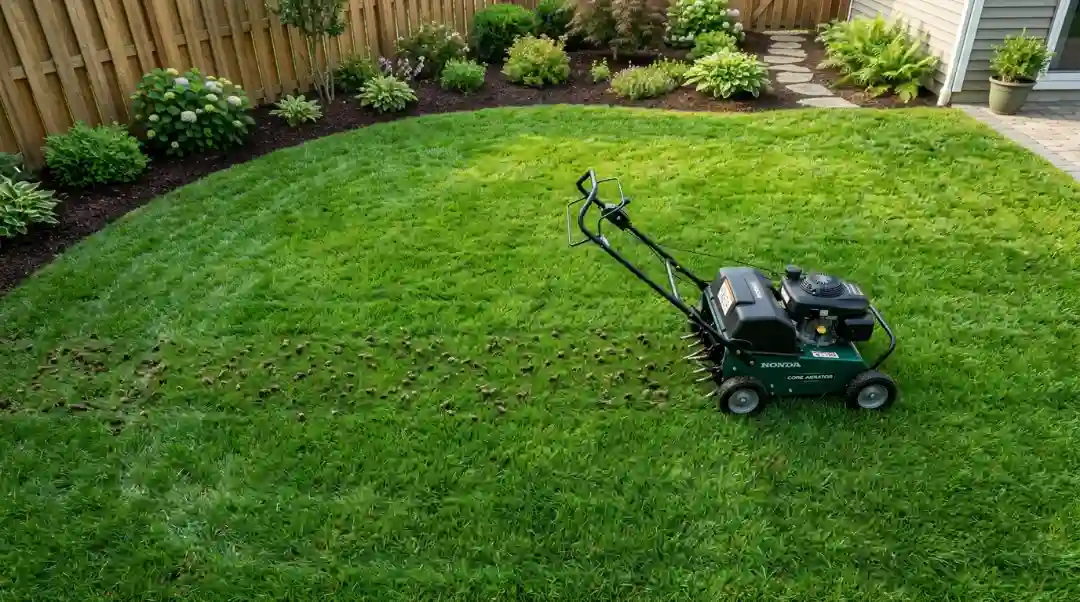
- When you aerate your lawn (aerating before fertilising improves absorption dramatically)
- Your overseeding schedule (fertilise 4–6 weeks after overseeding, not before)
- Any weed control applications (some weed and feed products combine both useful for lawns with grassy weeds or broadleaf problems)
How to Apply Lawn Fertiliser for Best Results
Timing is only half the battle. How you apply fertiliser matters just as much.
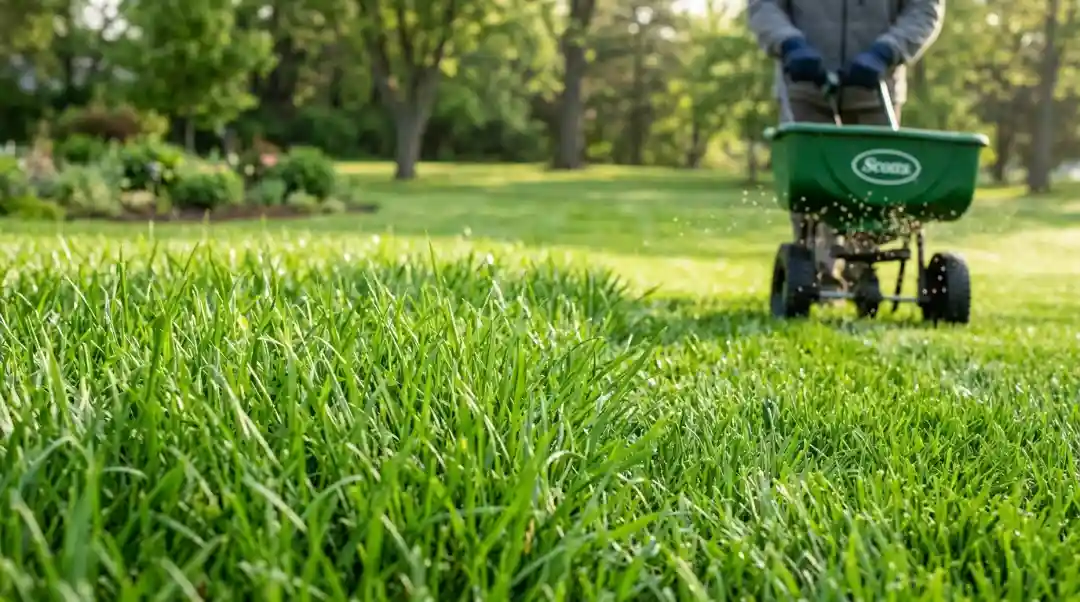
- Use the right spreader. A broadcast spreader gives even coverage across large lawns. A drop spreader is more precise for smaller or irregular areas.
- Don’t apply to wet grass. Fertiliser granules sticking to wet blades can cause fertiliser burn.
- Water after applying. This helps granules dissolve and move into the soil. Exception: don’t fertilise right before heavy rain, as excess runoff wastes product and can contaminate nearby waterways.
- Never over-apply. More is not better. Over-fertilising weakens the lawn, making it more vulnerable to pests, disease, and drought. It also contributes to environmental runoff.
- Mow before fertilising not after. Mowing stressed, recently fertilised grass slows recovery.
Common Fertilising Mistakes to Avoid
These are the errors that set lawns back by weeks:
- Fertilising dormant grass Nutrients go nowhere and money is wasted
- Using the same product year-round Spring and autumn lawns need different nutrient profiles
- Skipping the soil test You may be applying nutrients that are already in excess
- Ignoring weather forecasts Feeding before a frost or heatwave does real damage
- Not factoring in shade Shaded grass grows slower and needs less nitrogen than full-sun areas
Lawn Installation Services in Whittier
If your lawn is past the point of feeding alone whether it’s been neglected, drought-damaged, or just never looked right from the start fertilising schedules won’t fix the underlying problem. Sometimes the best move is starting fresh.
Robert’s Complete Care offers professional Lawn Installation Services in Whittier for homeowners who want a lawn that’s built to last, not just patched up season after season. From soil preparation to grass selection and establishment, the team handles it properly from the ground up. Once your new lawn is in, a structured fertilising programme keeps it looking its best year-round.
Get Top-Notch Fertilisation Help From a Lawn Care Pro
Knowing when to fertilise grass is genuinely half the work. But if you’re dealing with soil problems, persistent weeds, or a lawn that just won’t respond to feeding alone, working with a professional makes a measurable difference.
A lawn care pro brings soil testing, product knowledge, and a schedule that’s built around your specific grass type and climate not a generic calendar from a bag of fertiliser. For homeowners in Whittier and surrounding areas, Robert’s Complete Care offers full seasonal lawn care programmes that cover everything from feeding and weed control to aeration and overseeding.
Final Thoughts
Knowing when to fertilise grass isn’t complicated once you understand your grass type and seasonal growth patterns. Match your feeding schedule to those windows, test your soil, and use the right product for the right time of year. That’s the foundation of a healthy lawn.
If you’re in the Whittier area and want a professional eye on your lawn’s programme, contact Robert’s Complete Care today. Whether it’s a full lawn installation, a seasonal fertilising plan, or help getting on top of weeds and patchy growth, the team is ready to help you get results that last.
Frequently Asked Questions
How often should I fertilise my grass?
Most lawns need fertilising 2–4 times per year, depending on grass type. Cool-season grasses do well with 2–3 applications (spring, early autumn, late autumn). Warm-season grasses benefit from 3 applications during their active growing season from late spring through early autumn.
Can I fertilise grass in cold weather?
No. Fertilising when soil temperatures drop below 10°C (50°F) is largely ineffective. The grass isn’t actively growing, so roots won’t absorb nutrients. Wait until consistent soil warmth returns in spring.
What’s the best fertiliser for grass in spring?
A balanced fertiliser with a higher nitrogen ratio such as a 30-0-4 or 28-0-6 NPK works well for spring feeding. It promotes green leaf growth after winter without overloading the lawn with phosphorus it doesn’t need yet.
Should I water grass after fertilising?
Yes. Watering within 24 hours of applying granular fertiliser helps it dissolve and move into the root zone. If you’re using a liquid fertiliser, light watering helps it settle without runoff.
Can I fertilise and overseed at the same time?
Not at the same time but close together works well. Overseed first, then wait 4–6 weeks for the new seedlings to establish before applying fertiliser. Applying too early risks burning the tender new roots.
How long should I keep pets off the lawn after fertilising?
Keep pets off for at least 24–48 hours after applying fertiliser. This gives granules time to dissolve into the soil. Ingesting synthetic fertiliser can cause digestive issues in pets, so it’s worth being cautious.
What happens if I over-fertilise my lawn?
Over-fertilising sometimes called “fertiliser burn” causes yellowing, browning, and in severe cases, dead patches. Excess nitrogen also makes the lawn more attractive to pests and fungal disease. If you’ve over-applied, water deeply and frequently for several days to flush the excess through the soil.