Your lawn might be getting watered, mowed, and fertilized on schedule yet it still looks patchy, thin, or tired. If that sounds familiar, compacted soil is likely the problem, and aeration is the fix. Most homeowners simply don’t know how often to do it, which is exactly why lawns suffer silently for years.
So, how often should you aerate your lawn? For most lawns, once a year is the sweet spot. Clay-heavy soils or high-traffic areas may need it twice a year, while sandy soils with healthy growth can go every two to three years. In this guide, we’ll walk through everything soil types, grass types, timing, tools, and what to do after aeration so you can make the right call for your specific lawn.
What Is Lawn Aeration?
Lawn aeration is the process of creating small holes in the soil to allow air, water, and nutrients to reach the grass roots. It directly addresses soil compaction one of the most common and overlooked reasons lawns stop thriving. Without it, even the best fertilizer won’t do its job properly.
Think of compacted soil like a sponge that’s been squeezed dry and left to harden. Water rolls off the surface instead of soaking in. Roots can’t push deep. Nutrients sit on top going nowhere.
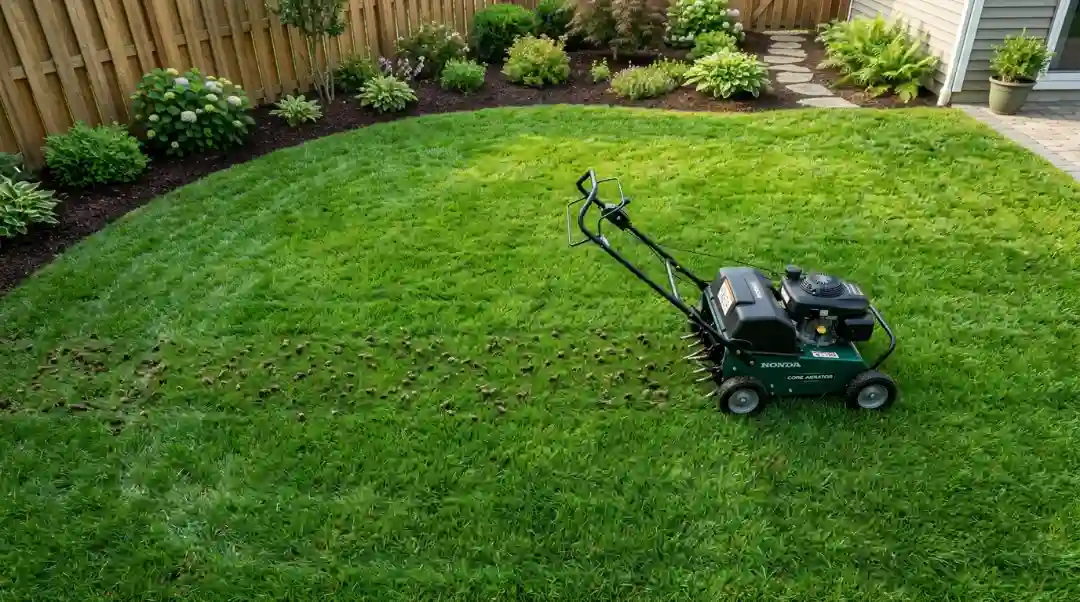
Core aeration fixes this by pulling out small plugs of soil about 2 to 3 inches deep and depositing them on the lawn surface. Those plugs break down naturally over a week or two, returning organic matter back into the soil.
What Is Dethatching And How Is It Different?
Dethatching removes the layer of dead grass, stems, and roots called thatch that builds up between the green blades and the soil. Aeration addresses compaction. Dethatching addresses buildup. They solve two different problems, but often both are needed at the same time.
A thin layer of thatch (under half an inch) is actually healthy it insulates the soil and retains moisture. But once thatch crosses the three-quarter-inch mark, it blocks water and oxygen from getting through.
To check: push your finger into the lawn. If you can’t reach the soil easily, the thatch layer is too thick. For compaction, try the screwdriver test push a standard screwdriver into the soil. If it doesn’t slide in easily, your lawn needs aeration.
What Does Aeration Actually Do to Your Lawn?
At the root level, aeration does three things:
- It breaks up compacted soil so oxygen, water, and nutrients reach turfgrass roots
- It creates natural pockets in the soil that improve seed-to-soil contact for overseeding
- It supports deeper root establishment, which leads to a more drought-resistant lawn
The result isn’t instant. But within two to four weeks after aeration, most lawns show noticeable improvement in color, density, and recovery speed.
How Often Should You Aerate Your Lawn?
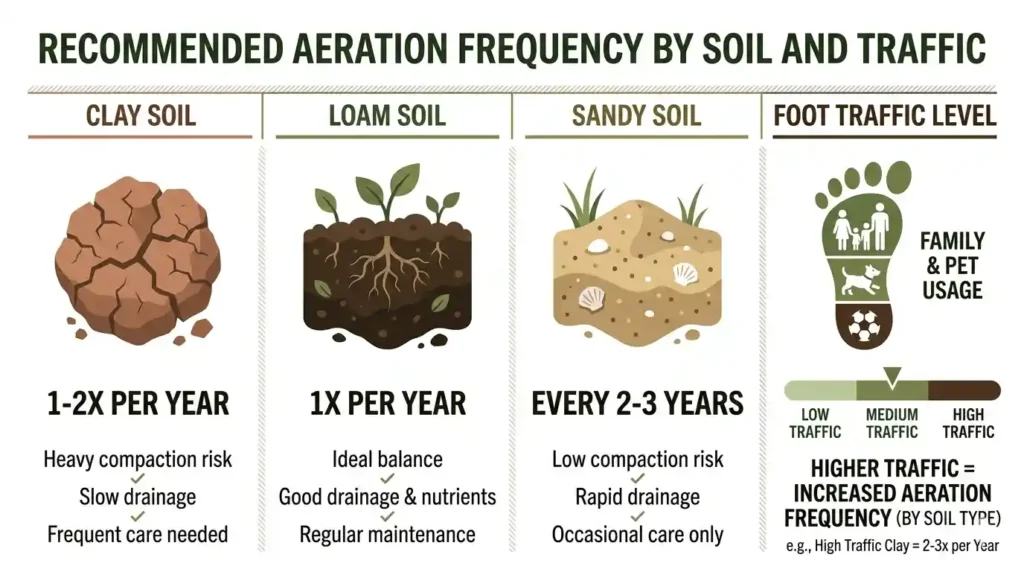
The right aeration frequency depends on your soil type, grass type, how much foot traffic your lawn takes, and the overall health of the turf. There’s no single answer for every lawn but the guidelines below will point you in the right direction.
By Soil Type
| Soil Type | Recommended Frequency |
| Clay soil | Once or twice per year |
| Loam soil | Once per year |
| Sandy soil | Every 2 to 3 years |
Clay soil compacts the most because its particles are dense and pack tightly together. Sandy soil is naturally porous, so water and oxygen move through it more freely less aeration needed.
By Foot Traffic
High-traffic lawns those used for sports, kids’ play areas, or frequent outdoor entertaining compact faster. These should be aerated at least once a year, sometimes twice. A lawn that mostly sits untouched might only need it every two years.
By Lawn Age
Newly installed lawns often need more frequent aeration in the first three years as the soil settles and compacts from construction activity. Established lawns with good soil structure can be maintained with annual or bi-annual aeration.
By Grass Health
If your grass is growing well, green, and recovering quickly from stress you might not need to aerate every year. But if it’s thinning, showing dry patches, or not responding to fertilizer, those are clear signs it’s time.
When Is the Best Time to Aerate Your Lawn?
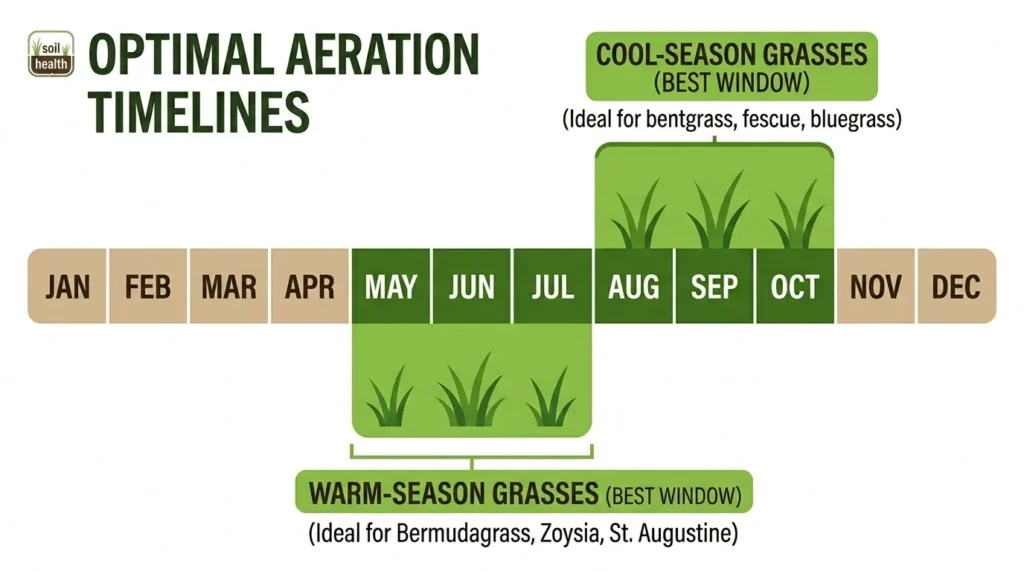
The best time to aerate is during your grass’s peak growing season not when it’s dormant or stressed. Aerating at the wrong time can do more harm than good, leaving open holes that dry out before the grass can recover.
Cool-Season Grasses (Fescue, Kentucky Bluegrass, Perennial Ryegrass)
Aerate in early fall (late August through September) or early spring. Fall is the preferred window because soil temperatures are still warm, weed pressure drops, and the grass has the whole cooler season to recover and fill in.
Spring aeration works too, but avoid it right before peak weed germination open aeration holes can act as seed beds for crabgrass and other weeds.
Warm-Season Grasses (Bermudagrass, Zoysiagrass, Bahiagrass)
Aerate from late spring through early summer once the grass has broken dormancy and is actively growing. Bermudagrass, in particular, responds very well to summer aeration combined with overseeding with perennial ryegrass in fall.
Can You Aerate Your Lawn Too Much?
Yes and it’s more common than most people think. Aerating too frequently on a healthy, low-traffic lawn can stress the turf unnecessarily, disrupt root zones that are already well-established, and create bare spots that invite weeds.
The rule is simple: aerate when the lawn needs it, not on a fixed schedule regardless of condition. Walk across the lawn after light rain. If the soil feels rock solid rather than slightly giving, it’s compacted. If it feels normal, hold off.
For healthy lawns with good soil structure and regular maintenance, every two to three years is often enough.
Core Aeration vs. Spike Aeration Which Is Better?
Core aeration is significantly more effective than spike aeration for compacted soils. Spike aerators push soil aside to create holes, which can actually increase compaction around the hole. Core aerators remove soil plugs entirely, creating real relief for compressed roots.
Spike shoes and manual spike tools are the most common DIY option and unfortunately, the least effective one for serious compaction. They’re fine for very light maintenance on already-healthy lawns.
For any real compaction issue, rent or hire a core (plug) aerator. Professional models remove plugs at about half-inch diameter and 2 to 3 inches deep, spaced roughly 2 to 3 inches apart that’s the standard that actually moves the needle.
Liquid aeration is a newer option that uses soil conditioners to loosen compaction without physical plug removal. It’s convenient but best used as a supplement to core aeration, not a replacement.
How Deep to Aerate Your Lawn
Aerator plugs should go 2 to 3 inches deep for effective results. Anything shallower than 1.5 inches won’t reach the compacted zone where water and nutrient flow is actually being restricted.
Most rental core aerators are already set to the right depth. When renting, ask the agency to confirm the tine depth is appropriate for your grass type some warm-season grasses with shallower root systems need slightly adjusted settings.
Can I Aerate in the Spring?
Yes, spring aeration is a valid option especially for cool-season grasses that didn’t get fall aeration. Just keep two things in mind:
- Wait until the ground has thawed completely and the grass has started actively growing
- Avoid aerating right before applying pre-emergent herbicide aeration disrupts the soil barrier that pre-emergent products rely on
If you’re overseeding in spring, aerate first for better seed-to-soil contact, then skip the pre-emergent since it will also block your grass seed.
What to Do After Aerating Your Lawn
Getting the post-aeration steps right is just as important as the aeration itself.
Leave the plugs on the lawn. Those soil cores sitting on the surface will break down within 1 to 2 weeks. They return organic matter back to the soil don’t rake them up.
Overseed immediately. Aeration creates the perfect pocket for seed germination. If your lawn has thin or bare patches, overseeding right after aeration gives you the best seed germination results. Water 5 to 10 minutes in the morning and evening until seedlings establish usually 10 to 14 days.
Fertilize after aeration. With the soil now open and receptive, a slow-release fertilizer will absorb much more efficiently. Apply within 48 hours of aeration for best results.
Water well. Water your lawn the day before aeration to soften the soil. After aeration, water every 2 to 3 days for the next two weeks to help roots recover and seedlings establish.
After Aerating Lawn When to Mow
Wait until new seedlings reach at least 3 to 3.5 inches tall before mowing. Make sure your mower blade is sharp dull blades tear tender new growth instead of cutting it cleanly. For lawns without overseeding, you can mow once the plugs have broken down and the lawn looks settled, usually about 1 to 2 weeks.
Does Your Lawn Actually Need Aeration? (Quick Checklist)
Before scheduling aeration, run through this quick check:
- Does water pool on the surface after rain instead of soaking in?
- Does the screwdriver test fail (can’t push it 2 inches into soil easily)?
- Is the lawn thin, patchy, or slow to recover from heat stress?
- Does heavy foot traffic cross the same area regularly?
- Has it been more than two years since the last aeration?
If you checked two or more of these your lawn is ready for aeration.
Common Lawn Aeration Mistakes to Avoid
Using spike shoes instead of a core aerator. Spike tools compact soil around the puncture point, making the problem worse in dense clay soil.
Aerating at the wrong time. Aerating dormant grass or grass under heat stress won’t give it the recovery window it needs. Stick to the peak growing season for your grass type.
Skipping the watering step. Aerating dry, bone-hard soil means the tines can’t reach the proper depth. Water the lawn 24 hours before aeration.
Applying pre-emergent weed killer right after aerating. The two treatments conflict pre-emergent creates a chemical barrier that aeration will break. Choose one or space them out by at least 4 to 6 weeks.
Trying to control weeds right after overseeding. Hold off on herbicide until the new seedlings have been mowed two to three times roughly 4 to 6 weeks after germination.
DIY vs Professional Lawn Aeration
DIY aeration works well for small lawns with mild compaction, while professional aeration is often better for large yards, severe compaction, or clay-heavy soil. Professional equipment usually removes deeper and cleaner soil plugs.
Rental machines can be heavy and awkward to handle.
Professionals often provide:
- deeper core removal
- proper spacing
- overseeding services
- lawn evaluations
For homeowners in California looking for healthy turf and long-term soil care, professional help can save time and prevent costly lawn damage.
If your lawn struggles with compacted soil, patchy grass, or drainage issues, consider scheduling professional Lawn Installation Services in Whittier through Robert’s Complete Care. Proper soil preparation and lawn maintenance often make a major difference in long-term turf health.
Final Thoughts
Aeration is one of the most overlooked parts of lawn care and one of the highest-impact things you can do for long-term lawn health. Getting the timing right, using the right equipment, and following up with overseeding and fertilization makes the whole process genuinely worth it.
If you’re unsure about your soil type, grass type, or whether your lawn actually needs aeration this season, Robert’s Complete Care is here to help. Reach out through our contact us and we’ll assess what your lawn actually needs no guesswork required.
Frequently Asked Questions
How often should you aerate your lawn if you have clay soil?
Clay soil compacts quickly, especially in high-traffic areas. Aerate once or twice per year once in fall for cool-season grass, or once in late spring for warm-season grass. In areas with heavy use, twice annually keeps the soil from locking up between seasons.
Should you aerate your lawn every year?
Not necessarily. Annual aeration is a good baseline for clay soils and high-traffic lawns. Lawns with sandy or loam soil that are performing well can go every two to three years. Let the condition of the lawn guide the schedule, not the calendar alone.
How often to aerate lawn with healthy, established turf?
Healthy lawns that receive regular fertilization, watering, and mowing and show no signs of compaction can often go 2 to 3 years between aeration sessions. Over-aerating healthy turf offers little benefit.
Can you aerate too much?
Yes. Frequent aeration on a healthy lawn can disrupt established root zones and create unnecessary stress. Once a year is the maximum for most lawns, and only when signs of compaction are present.
What’s the best time to aerate cool-season grasses?
Late August through early October is ideal. The soil is still warm enough for quick recovery, and overseeding at this time sets up strong germination before the first frost.
Does aeration help with weeds?
Indirectly, yes. A dense, healthy lawn that develops after consistent aeration and overseeding naturally crowds out weeds by reducing bare spots. However, avoid post-emergent herbicides for 4 to 6 weeks after overseeding to protect new seedlings.