Picking the wrong lawn mower is like buying hiking boots for a flat city commute. It works, but it’s not right for the job. If you’ve been going back and forth on the self-propelled vs push mower debate, you’re not alone. Millions of homeowners face this exact question every spring, and the wrong choice costs them time, money, or both.
Here’s the quick answer: A self-propelled mower is better for large, hilly, or uneven yards over 1/4 acre. A push mower is the smarter choice for small, flat lawns under 1/4 acre where budget and simplicity matter most. The rest of this article breaks down every difference so you can buy with confidence, not guesswork.
What Is a Self-Propelled Mower?
A self-propelled mower uses a built-in drive system to move itself forward. You guide it; the motor does the pushing. It’s powered by a gas engine or an electric motor (corded or battery-powered), and the drive system connects directly to the wheels.
Most models let you control the speed through a lever or bail bar on the handlebar. Some high-end models even offer variable speed, which adjusts to your natural walking pace. If you have a bad back, knee problems, or a yard larger than a quarter acre, this type of mower changes the experience entirely.
Types of Self-Propelled Drive Systems
Not all self-propelled mowers are built the same. The drive type affects how well the mower performs on your specific yard.
- Front-Wheel Drive (FWD): Best for flat to slightly uneven lawns. Easier to steer around flower beds and obstacles. Less traction on steep slopes.
- Rear-Wheel Drive (RWD): Better grip on hills and slopes. The most popular choice for yards with any incline.
- All-Wheel Drive (AWD): Maximum traction on challenging, uneven, or wet terrain. Heavier and more expensive, but the most capable option overall.
What Is a Push Mower?
A push mower moves only when you push it. The engine (if it has one) powers the cutting blades, not the wheels. Your body provides forward motion.
Push mowers are lighter, simpler, and cheaper than self-propelled models. They’re ideal for homeowners with small, flat yards who want a low-maintenance tool that gets the job done without extra complexity.
Types of Push Mowers to Consider
- Manual Reel Mowers Zero emissions, completely quiet, and the cheapest option available. The blades spin as you push. Best for short, well-maintained grass on small lawns. Not suitable for tall or thick turf.
- Electric Push Mowers (Corded or Battery) Quieter than gas, produce no direct emissions, and require less maintenance. Battery-powered models (20V to 60V) are the most convenient for small to medium yards. Corded models are cheaper but limit your range.
- Gas-Powered Push Mowers More cutting power (125cc to 160cc engines) and no battery runtime concerns. Best for medium-sized, flat lawns with thicker grass. Noisier and produces exhaust, which is worth considering if you’re in a residential area.
Self-Propelled vs Push Mower: Head-to-Head Comparison
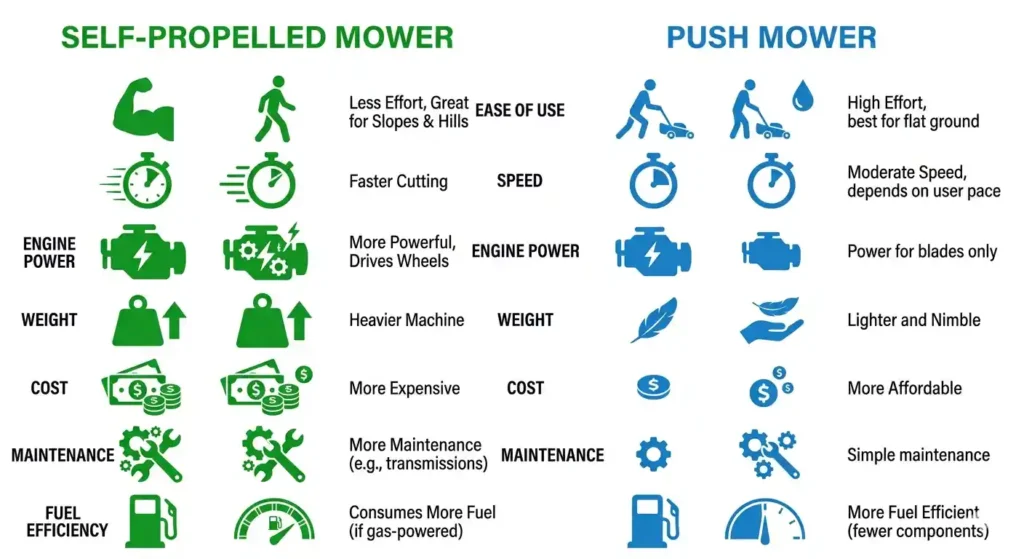
| Feature | Self-Propelled | Push Mower |
| Ease of Use | Easier on large/hilly lawns | Simple on small, flat lawns |
| Speed | 3 to 4 mph (consistent) | Depends on your pace |
| Engine Power (Gas) | 140cc to 220cc | 125cc to 160cc |
| Battery Power | 20V to 120V | 20V to 60V |
| Weight | 45 to 110 lbs | 35 to 65 lbs |
| Cutting Width | 18 to 33 inches | 13 to 22 inches |
| Fuel Efficiency | Uses 10-25% more fuel | Highly efficient |
| Maintenance | Higher (drive system upkeep) | Lower (fewer parts) |
| Average Cost | $330 to $2,200 | $130 to $800 |
| Best For | Large, hilly, or uneven yards | Small, flat, obstacle-heavy yards |
Ease of Use
Self-propelled mowers are easier to use on medium to large lawns, hilly terrain, and thick grass. Push mowers are simpler and more manageable on small, flat lawns with many tight corners or obstacles.
With a self-propelled model, the drive system handles the hard work. You’re essentially steering, not fighting. On the other hand, a push mower puts 100% of the movement effort on you, which gets tiring fast on anything larger than 1/3 acre.
Speed and Efficiency
Self-propelled mowers hold a steady 3 to 4 mph, even on moderate inclines. That consistent pace produces a more even cut and gets the job done faster. Push mowers depend entirely on how fast and how long you can sustain a walking pace, which naturally slows down as fatigue sets in.
Fuel Efficiency
Push mowers win here. They use 10% to 25% less fuel than self-propelled models because the engine only powers the blades, not the wheels. If you’re mowing weekly and fuel costs matter to you, this adds up over a full season.
Weight and Maneuverability
Push mowers (35 to 65 lbs) are easier to lift, turn, and store than self-propelled models (45 to 110 lbs). If your yard has lots of garden beds, tight corners, or curbing, a push mower gives you faster response and more precise steering.
Noise Level
Gas-powered self-propelled mowers tend to be louder due to their larger engines. If you live in a suburban neighborhood with noise restrictions, an electric push mower or battery self-propelled mower is worth considering. Your neighbors will thank you.
Maintenance Requirements
This is where push mowers have a clear edge. Fewer moving parts means less that can break. Annual maintenance on a gas push mower involves an oil change, air filter replacement, spark plug check, and blade sharpening. That’s it.
Self-propelled mowers need all of the above, plus drive belt inspections, drive cable adjustments, and drive gear lubrication. These repairs often require a trip to a service shop, not just a Saturday afternoon in the garage.
Cost Comparison
A basic push mower starts around $130. Premium models with electric start and wider decks run $600 to $800. Manual reel mowers cost as little as $60.
Self-propelled mowers start around $330 and can exceed $2,200 for commercial-grade models. The higher price reflects the more powerful engine, stronger frame, and drive system hardware. Budget for repairs too. The drive system is the first thing to wear out.
Mowing on Hills and Slopes: Which Is Safer?
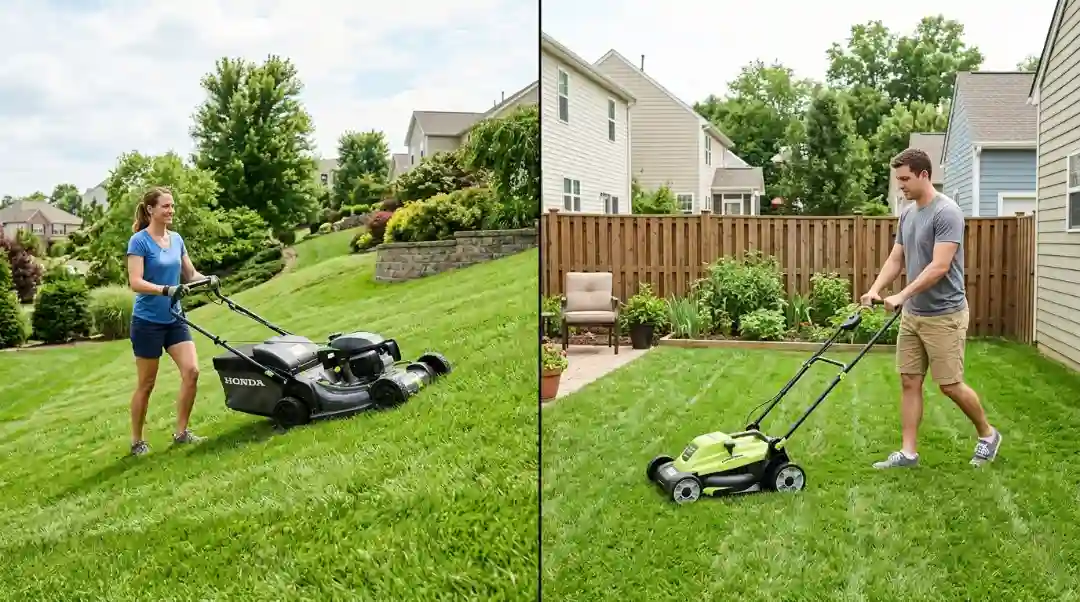
Self-propelled mowers, especially rear-wheel drive and all-wheel drive models, are significantly safer and more effective on slopes than push mowers.
On a steep incline, pushing a heavy mower uphill is not just tiring. It’s a safety risk. The mower can slip backward, and you lose control. A rear-wheel drive self-propelled mower grips the ground and maintains forward momentum without you straining to keep it moving.
A general safety rule: avoid mowing slopes steeper than 15 degrees with any walk-behind mower. For steeper grades, a riding mower or professional service is the safer call.
Storage and Portability: A Factor Most People Ignore
Self-propelled mowers take up more garage space due to their weight and bulk. Some models offer folding handles or vertical storage designs to help, but they’re still harder to move around than push mowers.
If you live in an apartment or have a small storage area, a lightweight electric push mower or a compact reel mower makes a lot more practical sense. Portability also matters if you transport the mower in a truck or trailer.
Environmental Impact: Which Mower Is Greener?
Manual reel mowers produce zero emissions and zero noise. They’re the most eco-friendly option by a wide margin.
Battery-powered mowers (both push and self-propelled) produce no direct emissions during use. Corded electric models use roughly 0.7 to 1.2 kWh per hour. Gas-powered models of both types emit CO2, carbon monoxide, volatile organic compounds (VOCs), and nitrogen oxides (NOx).
If reducing your carbon footprint matters to you, an electric option in either category is the smarter pick.
Common Mistakes When Buying a Lawn Mower
Most buyers regret their mower purchase for one of these three reasons:
- Buying for the wrong yard size. A push mower on a half-acre hilly yard is exhausting. A heavy self-propelled mower on a tiny flat lawn is overkill. Match the tool to the terrain.
- Ignoring the terrain type. Flat and hilly lawns are two completely different mowing experiences. A front-wheel drive self-propelled mower won’t give you the traction you need on slopes.
- Underestimating maintenance costs. Self-propelled mowers cost more to maintain. If you’re not ready to service the drive system, factor in shop costs or pick a simpler push model.
Who Should Choose a Self-Propelled Lawn Mower?
A self-propelled mower is the right call if:
- Your yard is over 1/4 acre
- You have hills, slopes, or uneven terrain
- You grow thick turf like St. Augustine or Bermudagrass
- You deal with physical limitations like back pain or knee problems
- You often miss mowing schedules and deal with tall, overgrown grass
- You want a consistent, even cut with less effort
Who Should Choose a Push Mower?
Stick with a push mower if:
- Your yard is under 1/4 acre and flat
- Your lawn has many obstacles, tight corners, or curbing
- Budget is a priority, both upfront and for maintenance
- You prefer simple tools with fewer parts to worry about
- You keep a regular mowing schedule and the grass never gets too long
- You want a lighter mower that’s easy to store and transport
Lawn Care in Whittier? We Can Help
If you’re located in Whittier and want a perfectly maintained lawn without the hassle of choosing the right equipment, Robert’s Complete Care handles it for you. Our team provides professional landscaping maintenance in Whittier, from regular mowing and edging to seasonal lawn care. No equipment decisions, no maintenance headaches. Just a clean, healthy yard every time.
Frequently Asked Questions
Can you push a self-propelled mower without the drive on?
Yes, you can push a self-propelled mower manually by disengaging the drive system. Most models have a simple lever or bail bar that turns the drive off. However, because self-propelled mowers are heavier than push mowers, manually pushing one for an entire lawn session is tiring and not ideal.
Some homeowners disengage the drive on flat sections to save battery or fuel and only engage it on hills. That’s a practical approach that extends runtime.
Are self-propelled mowers worth it?
Self-propelled mowers are worth it if your yard is over 1/4 acre, has slopes, or if you have physical limitations. For small, flat yards, the extra cost and maintenance are hard to justify. The value depends entirely on your specific lawn conditions.
For most homeowners with medium to large yards, the time and energy savings over a full season make the higher price reasonable.
Is a self-propelled mower good for exercise?
A push mower burns more calories. Pushing a mower at a steady pace burns roughly 250 to 350 calories per hour depending on body weight and terrain. If fitness is part of your mowing motivation, a push mower gives you that benefit. A self-propelled mower reduces that physical output significantly.
Do self-propelled mowers last as long as push mowers?
Push mowers generally last longer. Fewer parts means fewer failure points. A well-maintained push mower can last 10 or more years. Self-propelled mowers average 7 to 10 years, with drive components being the most common reason for early retirement.
What’s the difference between front-wheel and rear-wheel drive self-propelled mowers?
Front-wheel drive is better for flat lawns with lots of obstacles because it makes turning easier. Rear-wheel drive provides better traction on slopes and hills. If your yard has any significant incline, rear-wheel drive is the better investment.
Which mower is better for bagging grass clippings?
Self-propelled mowers handle bagging better. They typically include larger bags (20 to 30 gallons), sturdier mounting systems, and better airflow channels. The consistent speed also means clippings are cut more evenly, which makes collection cleaner and more efficient.