It’s like buying hiking boots for a beach vacation if you get the incorrect mower. It works, but you’ll always regret it. Most homeowners either buy a self-propelled mower they don’t need or have to deal with a big, steep yard with a simple push mower. You wasted time, energy, and money on both mistakes.
This tutorial goes over everything you need to know about the self propelled vs push mower argument, including engine power, performance on different types of terrain, pricing, and maintenance. By the end, you’ll know exactly which mower is best for your grass, your budget, and your body.
What Is a Self-Propelled Mower?
A self-propelled mower uses a built-in drive system to move itself forward. You guide it; the motor does the pushing. This drive system connects to the wheels, not just the blades, which is what separates it from a standard push mower.
Most models let you control the speed through a lever or bail bar on the handlebar. Some offer variable speed, which means you can match the mower’s pace to your walking speed. Gas-powered models typically run between 140cc and 220cc, while battery-powered versions range from 20V to 120V.
Types of Drive Systems: FWD, RWD, and AWD
Not all self-propelled mowers drive the same way, and this matters more than most buyers realize.
Front-Wheel Drive (FWD): Best for flat, obstacle-filled yards. FWD mowers are easy to pivot around flower beds and trees, but they lose traction on slopes when you lift the front wheels slightly to turn.
Rear-Wheel Drive (RWD): The go-to for hilly or uneven terrain. The rear wheels grip the ground better on inclines, giving you more stability and control going uphill.
All-Wheel Drive (AWD): Handles the toughest terrain, including wet grass, steep slopes, and mixed landscapes. AWD mowers cost more, but for complex yards, they’re worth it.
What Is a Push Mower?
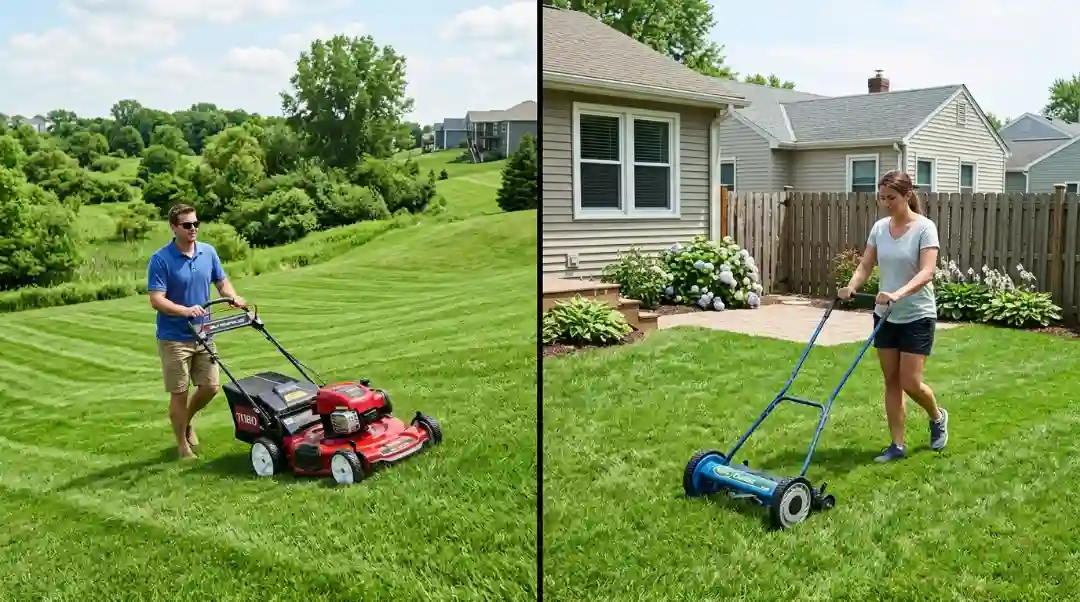
A push mower moves only because you push it. The engine (if it has one) powers the cutting blades, but your legs power the forward movement. It’s straightforward, reliable, and low-maintenance.
Bold answer: A push mower is a walk-behind mower where the operator provides all forward movement manually. The engine or motor runs only the cutting blades. Push mowers are lighter, cheaper, and easier to maintain than self-propelled models, making them ideal for small, flat lawns under 1/4 acre.
Push mowers come in three main types, and choosing the right one makes a real difference.
Types of Push Mowers to Consider
Manual Reel Mowers: No engine at all. The spinning cylindrical blades are powered entirely by your forward motion. They’re quiet, eco-friendly, and perfect for small, well-maintained lawns. They won’t handle tall or thick grass well.
Electric Push Mowers: Corded or battery-powered. They run the blades with an electric motor while you provide forward movement. Quieter than gas, zero emissions, and lower maintenance. Battery models typically range from 20V to 60V.
Gas-Powered Push Mowers: Engine displacement usually falls between 125cc and 160cc. More cutting power than electric models, but noisier and they produce exhaust. Best for slightly larger flat lawns where you need reliable blade power.
Head-to-Head Comparison: Self-Propelled vs Push Mower
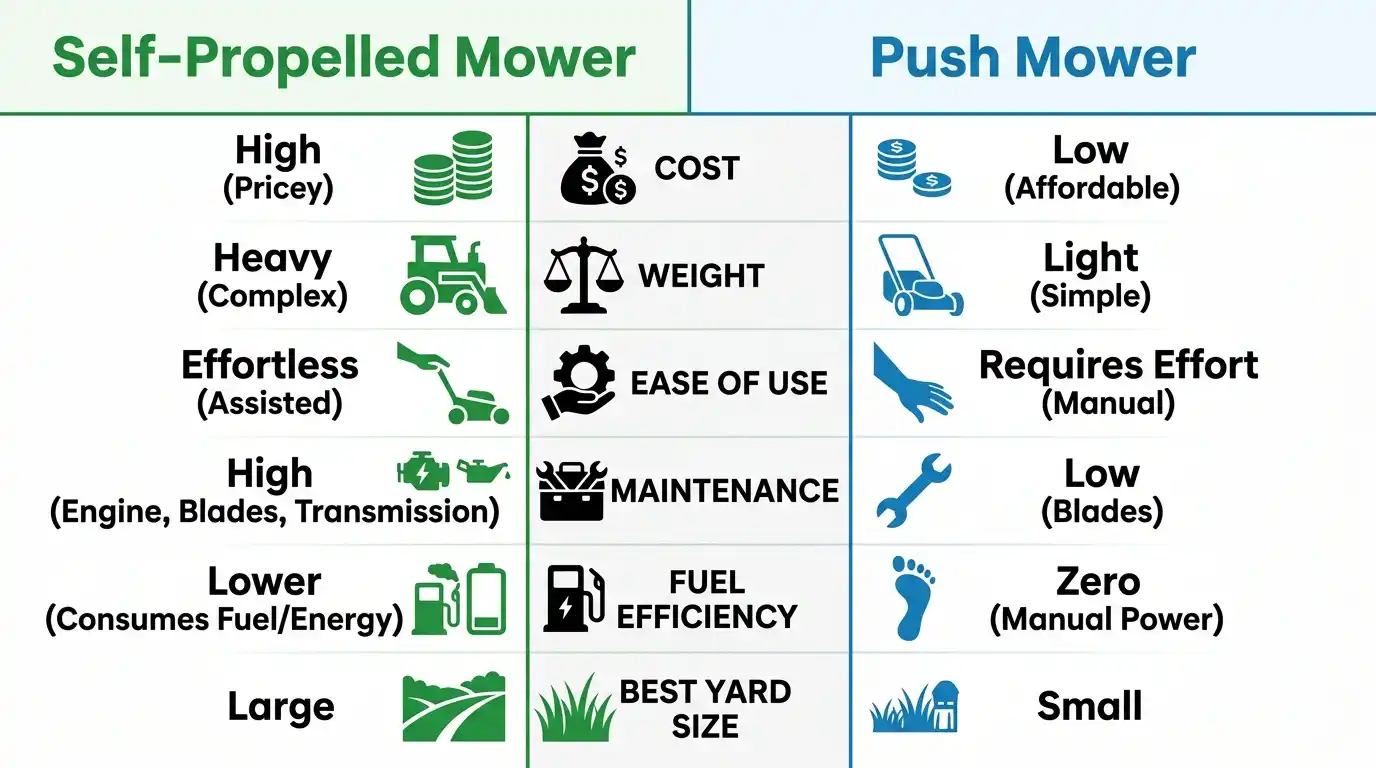
Here’s a direct breakdown across the categories that actually matter to most homeowners.
Ease of Use
Self-propelled mowers reduce physical strain significantly. If you have a bad back, knee problems, or simply don’t want to break a sweat, a self-propelled model handles the heavy work. Push mowers are simpler to operate on small, flat lawns since there’s no drive system to manage.
Power and Engine Size
Self-propelled mowers carry more powerful engines to handle both propulsion and blade rotation. Gas models run 140cc to 220cc. Push mowers use smaller engines, 125cc to 160cc, because 100% of that power goes straight to the blades.
Speed and Cutting Efficiency
Self-propelled mowers hold a steady 3 to 4 mph regardless of fatigue. Push mowers depend entirely on your pace, which slows down naturally as you tire, especially on warm days or large areas. Inconsistent speed often leads to uneven cuts.
Weight and Maneuverability
Push mowers weigh between 35 and 65 pounds. Self-propelled models range from 45 to 110 pounds due to the added drive system hardware. However, because the drive system carries the mower’s weight during use, you rarely feel that extra weight while mowing. In tight spaces with lots of obstacles, a push mower still wins on pure maneuverability.
Fuel Efficiency
Push mowers are more fuel-efficient because the engine only runs the blades. Self-propelled mowers use 10% to 25% more fuel to power the drive system on top of the blades. Over a full season, that difference adds up.
Noise Levels
Gas-powered self-propelled mowers typically operate at 85 to 95 decibels. Gas push mowers are similar, around 80 to 90 decibels. Electric versions of both types drop to roughly 60 to 75 decibels, a noticeable difference in suburban neighborhoods with close neighbors.
Maintenance Requirements
Push mowers are much simpler to maintain. Annual gas model maintenance covers an air filter change, spark plug replacement, and oil change. Electric versions need only battery checks and blade sharpening.
Self-propelled mowers require all of the above, plus regular inspection of the drive belt, drive cable lubrication, gear cleaning, and speed control adjustments. More moving parts means more potential failure points.
Cost Comparison
| Push Mower | Self-Propelled Mower | |
| Entry-Level | $60 (reel) / $130 (gas) | $330 |
| Mid-Range | $250 to $400 | $500 to $900 |
| Premium | $600 to $800 | $1,000 to $2,200+ |
The price gap is real. But for large or hilly yards, a self-propelled mower pays for itself in saved time and physical effort over a single season.
Self-Propelled Mowers: Which Drive Type Is Right for You?
Consider your yard’s layout before deciding between front-wheel drive (FWD), rear-wheel drive (RWD), or all-wheel drive (AWD).
For yards that are generally level with a few trees and garden beds scattered about, front-wheel drive makes turning and maneuvering a breeze. A vehicle with rear wheel drive (RWD) has superior grip and control on moderately hilly terrain. The most dependable, but more expensive, alternative if your lawn has a mix of hills, flat regions, and damp spots is all-wheel drive (AWD).
Which Mower Is Better for Your Yard Size?
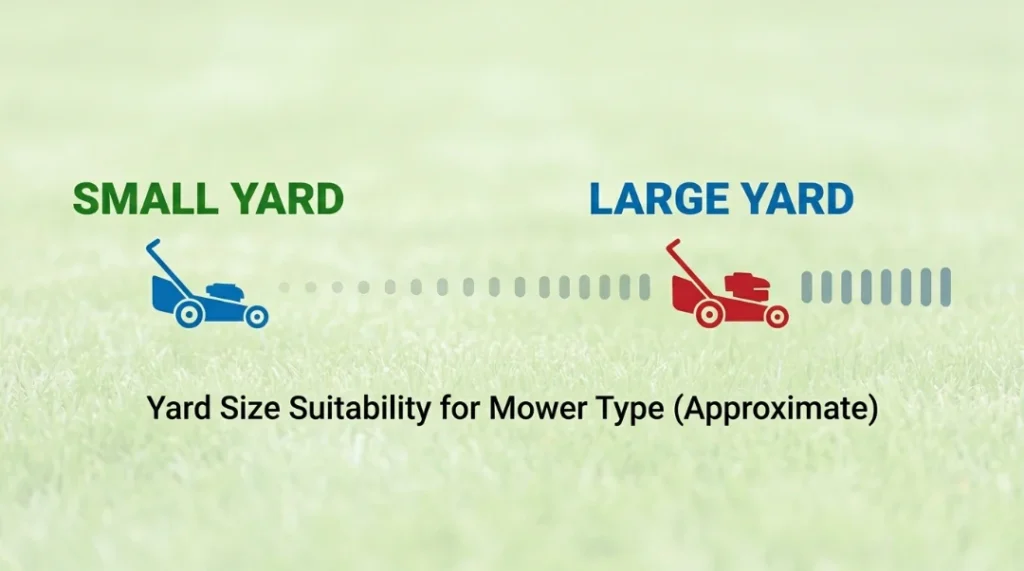 Yard size is the single most reliable deciding factor between these two mower types.
Under 1/4 acre: A push mower is the practical choice. It costs less, stores easily, and handles the job without overcomplicating things. A manual reel mower works well here if the lawn stays trimmed regularly.
1/4 to 1/2 acre: This is the gray zone. A push mower can still manage it, but mowing becomes a real workout, especially in summer heat. A self-propelled mower at this size will save you 20 to 30 minutes per session and reduce fatigue noticeably.
Over 1/2 acre: A self-propelled mower is the right tool. Anything larger than this and you should seriously consider a riding mower or zero-turn mower for true time efficiency.
Who Should Choose a Self-Propelled Mower?
Choose a self-propelled mower if any of these apply to you:
- Your lawn is larger than 1/4 acre
- Your yard has slopes, hills, or uneven terrain
- You have back problems, knee issues, or limited physical strength
- You grow thick grass varieties like St. Augustine or Bermudagrass
- You don’t mow on a tight schedule, so grass grows taller between sessions
- You’re 60 or older and want mowing to feel less like a workout
Who Should Choose a Push Mower?
A push mower makes more sense if:
- Your lawn is under 1/4 acre and relatively flat
- Your yard has many tight corners, narrow gates, or garden obstacles
- You’re working with a limited budget and want to keep costs down
- You mow regularly, so grass never gets too long or thick
- You prefer simpler equipment with fewer components to worry about
- You want a lighter mower that’s easier to store and transport
Special Considerations Most Buyers Overlook
Mowing Safety on Slopes
Self-propelled mowers are safer on slopes because the drive system keeps the mower moving at a controlled, consistent speed. With a push mower on a slope, there’s a real risk of the mower rolling back toward you if you lose grip or footing. For any incline steeper than 15 degrees, a rear-wheel drive or AWD self-propelled mower is the safer choice.
Senior Homeowners and Physical Limitations
This category doesn’t get talked about enough. As homeowners age, the physical demand of push mowing becomes a genuine barrier. A self-propelled mower with variable speed control and an ergonomic, adjustable handle can extend years of independent lawn care without requiring help or hiring out.
Storage and Portability
Push mowers are lighter and easier to store in tight garage spaces. Many models fold for vertical storage. Self-propelled mowers take more room due to their heavier frames. If your storage space is limited, this is a practical factor worth considering before buying.
Environmental Impact: A Quick Note
Gas-powered versions of both mower types produce meaningful emissions. According to the EPA, running a gas mower for one hour produces pollutants comparable to driving a car roughly 100 miles. Electric and battery-powered mowers of either type produce zero direct emissions during use.
If reducing your carbon footprint matters to you, an electric push or self-propelled mower is worth the investment. Battery technology has improved enough that 60V to 80V electric models now perform close to gas in most residential conditions.
Landscaping Maintenance in Whittier
If you’re in the Whittier area and still unsure which mower suits your specific yard, sometimes a professional eye makes all the difference. At Robert’s Complete Care, we handle full landscaping maintenance in Whittier for homeowners who want a well-kept lawn without the guesswork or the physical effort. From mowing and edging to seasonal cleanup, our team takes the work off your plate completely.
Conclusion
The choice between self propelled vs push mower comes down to how your lawn behaves day to day. A larger or uneven yard leans toward self-propelled, while a smaller, simple space works well with a push mower. Match the tool to the job, and mowing becomes quicker and less frustrating.
If the decision still feels unclear or you’d rather skip the trial and error, getting expert help can save time and effort. For reliable lawn care and consistent results, reach out to Robert’s Complete Care for professional guidance and support tailored to your yard.
Contact us today to get started and keep your lawn looking its best without the hassle.
Frequently Asked Questions
Is a self-propelled mower worth the extra cost?
For lawns over 1/4 acre or yards with any real slope, yes. The time and physical effort saved across a full mowing season makes the higher upfront cost reasonable for most homeowners.
What is the difference between self-propelled and push mower?
A self-propelled mower uses a drive system to move itself forward automatically. A push mower requires you to provide all forward movement manually. The engine in a push mower powers only the cutting blades.
Can you use a self-propelled mower as a push mower?
Yes. Most self-propelled mowers allow you to disengage the drive system and push manually. This is useful on flat sections where you want more control or want to conserve battery.
What is a push mower best for?
Push mowers work best on small, flat lawns under 1/4 acre with regular mowing schedules. They’re also better for yards with many tight turns, narrow passages, or multiple obstacles.
How do I use a push mower correctly?
Start by setting the cutting height to no more than 1/3 of the grass blade length. Mow in straight overlapping rows, and let the engine warm up for 30 seconds before engaging. Keep a steady walking pace for an even cut.
Which mower type lasts longer?
Push mowers generally last longer because they have fewer components that can wear out. No drive belt, no drive gears, and no propulsion system means fewer failure points over time.
What grass types need a self-propelled mower?
Thick, coarse grass varieties like St. Augustine, Bermudagrass, and Zoysia benefit from the extra power and consistent speed of a self-propelled mower, especially when growth gets ahead of a regular schedule.