It’s fun to lay new turf, but most homeowners make mistakes when it comes to keeping it alive. If you’ve recently laid down new sod or had a lawn put in by a contractor, you might be wondering how much to water new turf for the best chance of living. It dries out if you don’t give it enough. It drowns if it becomes too much. Getting this properly in the first few weeks is the most important thing.
This book explains in simple terms how much water fresh grass requires, when to water it, what to do each season, and the mistakes you should never make.
Why Proper Watering Is Critical for New Turf
A new lawn is not the same as an old one. When you lay sod, the roots are just approximately half an inch to an inch deep. The grass needs you for water until their roots reach the ground below. The lawn establishing period is the first few weeks after planting. It can run from 2 to 6 weeks, depending on the species of grass and the time of year.
The top inch of soil must keep wet throughout this period. If there isn’t any water farther down, the roots can’t chase it. You could lose sections of grass for good if the soil dries up even once during this time.
Think of it this way: new turfgrass sod is like a person who has just had surgery. It needs careful, regular care right after the surgery, not neglect, and not too much work.
The Role of Root Establishment
Root establishment is the process where the new grass sends roots down into your native soil, anchoring itself and becoming self-sustaining. Until this happens, watering is your number one job. Once roots are 2–3 inches deep and you can no longer easily lift a corner of sod, you’re entering the maintenance phase where watering becomes less frequent but deeper.
When to Water New Sod
What Is the Best Time to Water New Turf?
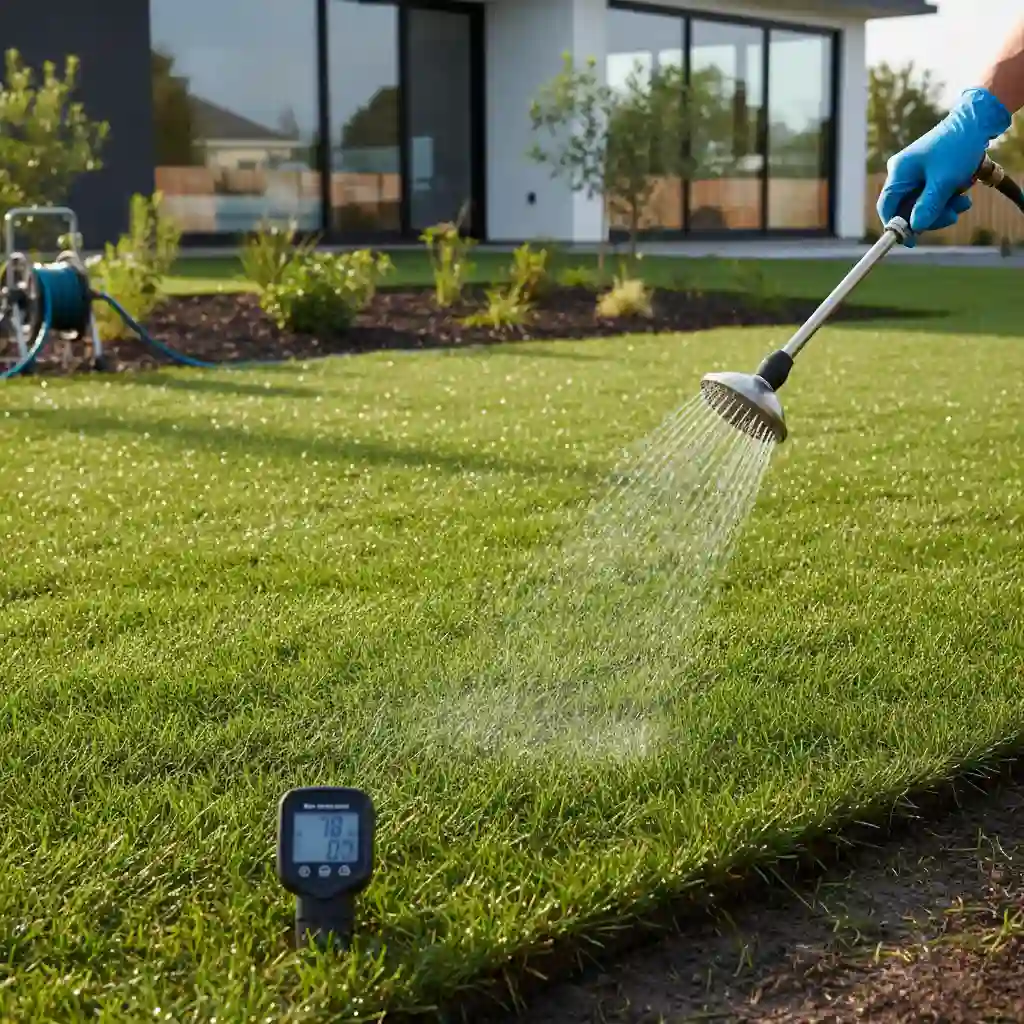
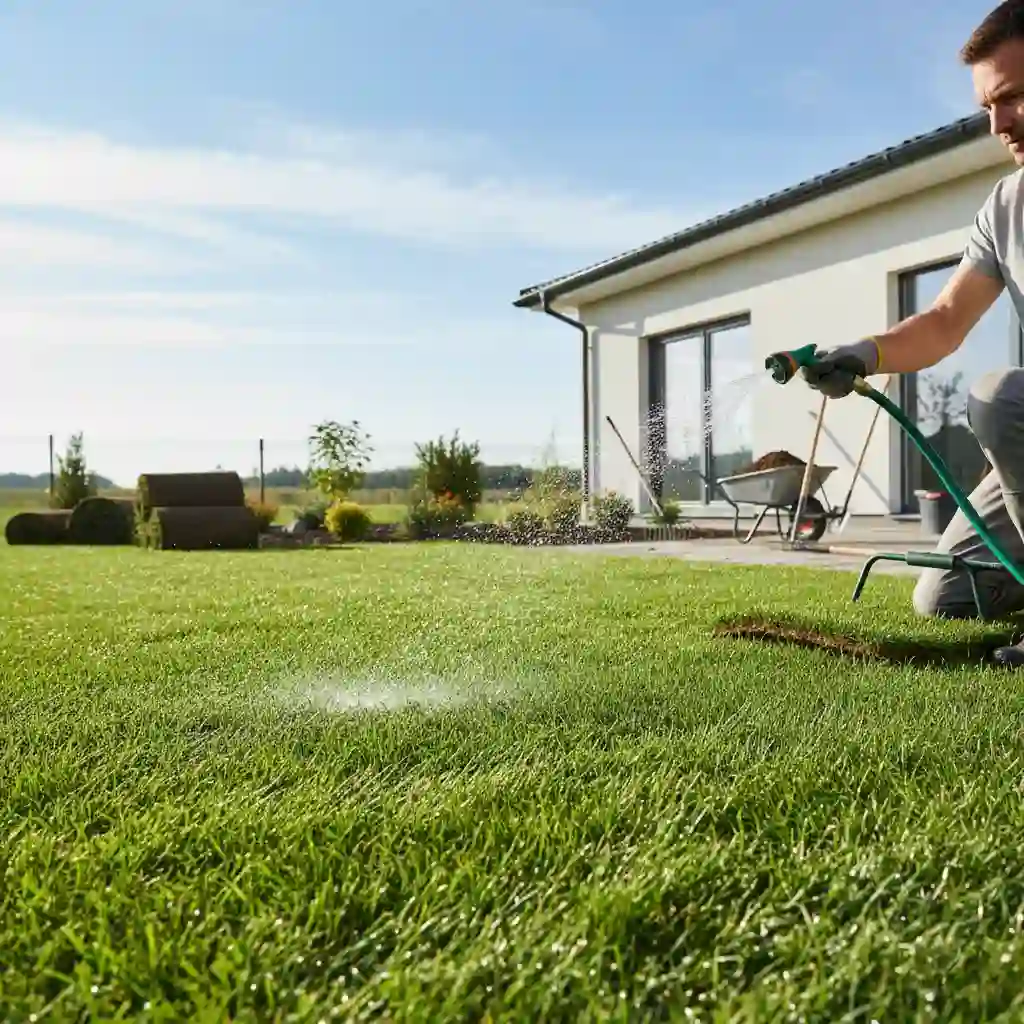
The optimal time to water fresh grass is in the morning, between 5 and 9 AM. The weather is cool right now, the wind is usually calm, and the sun hasn’t started to speed up the evaporation rate yet. Instead of evaporating off the surface, water soaks into the ground.
Don’t water in the middle of the day. Because of the heat and bright sun, most of the water evaporates before it can get into the ground. You squander water and don’t give the roots enough to drink.
People typically worry about watering in the evening. If the grass stays wet all night, it can get fungal diseases, which is an easy way to damage a young lawn that is otherwise healthy.
Quick Tip: If you absolutely must water during the day due to extreme heat in the first 24–48 hours after installation, do it. Heat stress can kill new sod faster than fungal risk in that critical window.
How to Water New Sod
Proper technique matters just as much as timing. Here’s how to do it right.
Step 1 Water Immediately After Installation
The moment new sod goes down, it needs water. Don’t wait until the next morning. Apply water within 30 minutes of laying each section. The first watering should saturate the soil 3–4 inches deep.
Step 2 Check Soil Moisture Daily
Every morning for the first two weeks, lift one corner of the sod. The dirt below should feel like a wet sponge, but not too wet. If it’s dry and crumbly, do it more often. If water is pooling or squishing, stop.
Step 3 Water in Overlapping Passes
Whether you’re using a sprinkler or an irrigation system, make sure your sprinkler coverage overlaps by about 30%. This prevents dry spots where the sprinkler patterns don’t quite reach; those are the brown patches you’ll notice in week two if you’re not careful.
Step 4 Reduce Frequency as Roots Establish
Slowly cut back on how often you water after the first two weeks. In week 3, stop watering every day and start watering every other day. In weeks 4–6, water 2–3 times a week. This makes the roots grow deeper, which is what you want because they are looking for water.
How Much Water Does a New Turf Need?
The Daily Water Target
New grass needs around 1 to 1.5 inches of water every day for the first two weeks. This sounds like a lot, but keep in mind that the idea is to keep the top 3–4 inches of soil wet all the time while the roots are growing.
After the establishment stage (weeks 3–6), cut back to 1 inch of water per week, which is the usual amount of water for most varieties of grass.
Is 30 Minutes of Watering Grass Enough?
This relies only on the sort of sprinkler you have and how much water pressure you have. A regular oscillating sprinkler might provide you with approximately 0.5 inches in 30 minutes, which isn’t enough during the establishment phase. A well-installed in-ground irrigation system with rotor heads might give you 0.75 inches in the same amount of time.
You can only be sure by measuring. For more on that, see the How to Measure Water Accurately section below.
New Turf Watering Schedule
Here’s a practical week-by-week watering new sod schedule for most climates:
Week 1–2: Heavy Establishment Phase Water 2–3 times per day, with sessions of 15–20 minutes each. Focus on morning watering, adding a mid-afternoon session only if temperatures are very high. The goal is to keep the top 3–4 inches of soil moist at all times. This is the most critical window of the entire new lawn watering guide.
Week 3–4: Tapering Phase Reduce to once per day in the morning, extending each session to 20–30 minutes. By this point, roots should be starting to anchor into the soil 4–6 inches deep. You’ll notice the sod feels more firm underfoot.
Week 5–6: Transition to Maintenance Move to every other day, running your sprinkler for 30–40 minutes per session. Roots should now be 2–3 inches deep. This is when you begin the shift to deep, infrequent watering that builds long-term drought resilience.
Week 7 and Beyond: Normal Maintenance Water 2–3 times per week, targeting a total of 1 inch per week. At this point your new turf has transitioned into a fully establishing lawn that no longer needs the intensive schedule of the first month.
Seasonal Watering Guide for New Turf
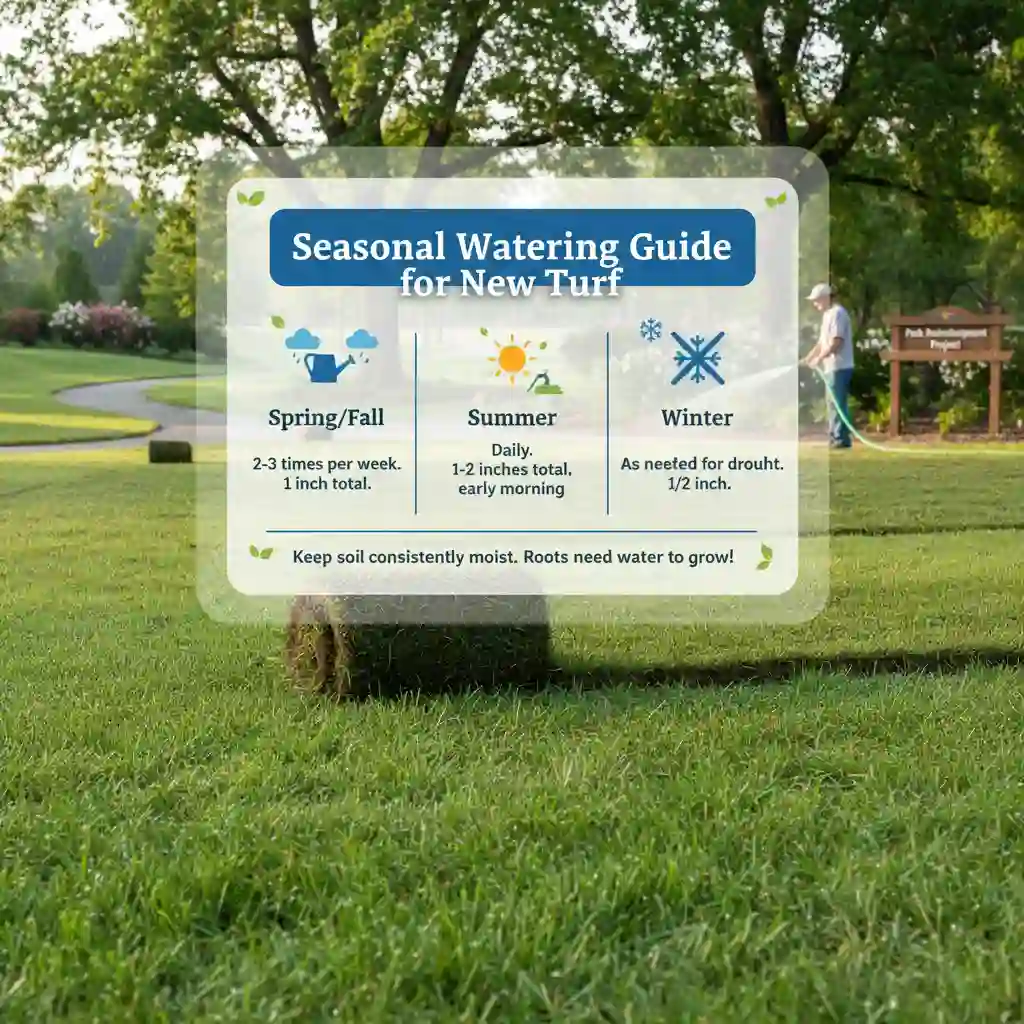
Summer Turf Watering Guide
Summer is the hardest time to establish new turf. Heat increases the evaporation rate dramatically, and new sod can dry out in just a few hours on a hot day. During a summer installation, water 3 times per day for the first week morning, early afternoon around 1–2 PM, and early evening. Check the sod every few hours during the first 48 hours, and if edges are curling or turning brown, water immediately regardless of the schedule. Avoid mowing until sod is firmly rooted, which typically takes about 3 weeks in summer heat.
A well-planned irrigation system makes summer establishment far more manageable. Robert’s Complete Care offers professional Irrigation System Services in Whittier to help ensure your new lawn gets precisely the right amount of water on an automated schedule especially critical during California’s hot months.
Winter Watering Guide
A lot of homeowners think that fresh grass doesn’t need water in the winter. That’s not completely true. Cool temperatures slow down evaporation, which means the soil stays moist longer. However, new grass still requires a steady supply of water to grow roots. Water once a day in the morning so that the soil can drain before the temperature drops at night. If it has rained at least 0.5 inches in the last 24 hours, don’t water. In places where there is frost, always water before 10 AM so the blades have time to dry before evening.
Should You Still Water Your Lawn in October?
Yes, especially if you’ve just put down new grass. Temperatures in October are colder and there is less evaporation, but new grass still needs regular water to grow roots. In October, try to water your plants 3 to 4 times a week, but change this if it rains. Established lawns can usually get by with just the rain that falls in the fall, but new grass needs to be watered even when it’s cold.
Best Sprinklers for New Turf
The right sprinkler makes a significant difference in how evenly and efficiently water is distributed.
Oscillating Sprinklers are best for small to medium rectangular lawns. They provide even coverage and are inexpensive. A run time of 30–45 minutes typically delivers about 0.5 — 0.75 inches of water, making them easy to calibrate with the tuna can test below.
Rotary and Impact Sprinklers are well suited for larger open areas. They cover more ground but can have inconsistent patterns near the edges, so pay attention to coverage when mapping your yard.
In-Ground Irrigation Systems are the gold standard for new turf. Automated drip and rotor systems deliver water precisely where it’s needed on a timer, removing the guesswork entirely. If you’ve recently used professional Lawn Installation Services in Whittier, pairing that work with an automated irrigation setup gives your new turf the best possible start from day one.
How to Measure Water Accurately
Guessing leads to over or under watering. Here’s a dead simple way to measure exactly how much your sprinkler delivers it’s called the tuna can test.
Place 3–5 empty tuna cans (or any flat-bottomed container of equal height) at different spots across your lawn inside the sprinkler’s coverage area. Run your sprinkler for exactly 15 minutes, then measure the depth of water collected in each can with a ruler. Average the measurements. That number tells you exactly how much water your sprinkler delivers in 15 minutes. From there, multiply to calculate how long you need to run it to hit 1 inch.
For example, if your cans average 0.25 inches after 15 minutes, you need to run your sprinkler for 60 minutes to deliver 1 full inch of water. Uneven readings between cans also reveal poor sprinkler coverage areas spots that need sprinkler head adjustments or additional coverage to prevent those frustrating dry patches.
Signs of Overwatering Turf
Overwatering is just as damaging as underwatering and sometimes harder to diagnose until the damage is done.
What Does Overwatered New Grass Look Like?
The first sign is usually grass blades turning yellow or pale green rather than a healthy deep green. The ground will feel squishy and waterlogged underfoot, and your footprints may hold their shape in the soft soil. You might notice visible puddles or water pooling after watering sessions. In more advanced cases, mushrooms or fungal growth will appear in patches, and the thatch layer may start to smell musty or feel slimy. Perhaps the clearest sign of all: the edges of the sod will be lifting away from the ground rather than rooting down into it.
Is Too Much Water Bad for a New Turf?
Of course. Waterlogged soil pushes away oxygen, which makes it hard for the roots to breathe. The roots of grass that is irrigated too much also stay shallow since they don’t have to grow deep to find water. This makes the lawn less able to handle drought for its whole existence. Fungal illness is another big concern that can happen later on, especially if you water your grass at night and keep it wet all night.
Signs of Underwatering Turf
Grass blades that fold in half lengthwise are one of the clearest signs of moisture stress; it’s the plant’s way of conserving what little water it has. Footprints that stay visible on the lawn for several minutes signal that the soil moisture is too low for normal cell rebound. The edges and seams between sod sections typically turn brown first when underwatering sets in, so watch those areas closely in week one. Pressing your fingers into the soil beneath a lifted sod corner and feeling dry, crumbly earth confirms the problem. A blue-grey tint on grass blades is another well-known indicator.
If you spot these signs, don’t panic-flood the lawn. Increase watering frequency gradually over 2–3 days to rehydrate the soil without causing runoff or compaction.
Is Heavy Rain Bad for New Turf?
A moderate, steady rain is actually great for new grass since it simulates the best watering conditions. But torrential rain that falls at a rate of more than 1 inch per hour is a different matter. That much rain makes water flow off the surface before it can soak into the ground, and it can even move recently placed sod on slopes or uneven land. Wait 24 hours after a hard rain before going back to your normal routine. Then, check the moisture level in the soil by hand. If it’s still wet enough, don’t go to the following session. Don’t ever think that your schedule should take precedence over what the soil is genuinely saying.
Common Mistakes to Avoid
Watering too shallowly is probably the most common error. Light, frequent sprinkles keep only the surface wet and actively encourage shallow root development. As you move into weeks 3 and 4, water less often but run the sprinkler longer so moisture penetrates deeper into the soil profile.
Watering at night creates the perfect humid conditions for fungal disease to take hold. Always default to morning watering, no exceptions.
Walking on new turf too soon compacts the soil and tears at roots that are still trying to anchor. Stay off the new lawn for at least 2–3 weeks, and use boards or stepping paths if you absolutely have to cross it.
Mowing too early is a mistake that catches many homeowners off guard. Mowing before the roots anchor can actually pull the sod right up off the ground. Wait until you try to lift a corner and it genuinely resists. Keep your first cut at a high blade setting no lower than 3 inches.
Ignoring seams and edges will cost you. The seams between sod rolls and the outer perimeter edges dry out first because they have less soil contact. Give these zones extra attention, particularly in the first week.
Assuming rainfall is enough is risky. A light shower rarely delivers a full inch of water even when it feels heavy. Check your soil after rain with the finger test rather than skipping your scheduled watering and hoping for the best.
Conclusion
If you want expert help with watering, installation, or long-term care of your new turf, our team at Robert’s Complete Care is here to help. We provide professional guidance, reliable service, and tailored solutions to keep your lawn healthy year-round. Contact us today to schedule a consultation and get your new turf off to the perfect start.
Frequently Asked Questions (FAQs)
Is too much water bad for new turf?
Yes. Overwatering causes root suffocation, fungal disease, and permanently shallow root systems. If the soil is consistently soggy, reduce watering frequency immediately.
What is the best time to water new turf?
Early morning between 5 AM and 9 AM. This allows water to soak deeply into the soil before heat and wind drive up the evaporation rate.
Is 30 minutes of watering grass enough?
It depends on your sprinkler type. Run the tuna can test to measure your output. Most standard sprinklers need 45–60 minutes to deliver a full inch of water.
Is heavy rain bad for new turf?
Gentle rain is beneficial. Heavy rain over 1 inch per hour can cause surface runoff and dislodge sod. Skip your scheduled watering for 24 hours after heavy rain and check soil moisture by hand.
What does overwatered new grass look like?
Yellow or pale green blades, soggy spongy ground, fungal growth in patches, and sod edges that lift rather than root down into the soil.
Should you still water your lawn in October?
Yes, especially newly laid turf. October is cooler and requires less frequent watering, but new sod still needs moisture for root establishment. Aim for 3–4 waterings per week unless rainfall is consistently sufficient.