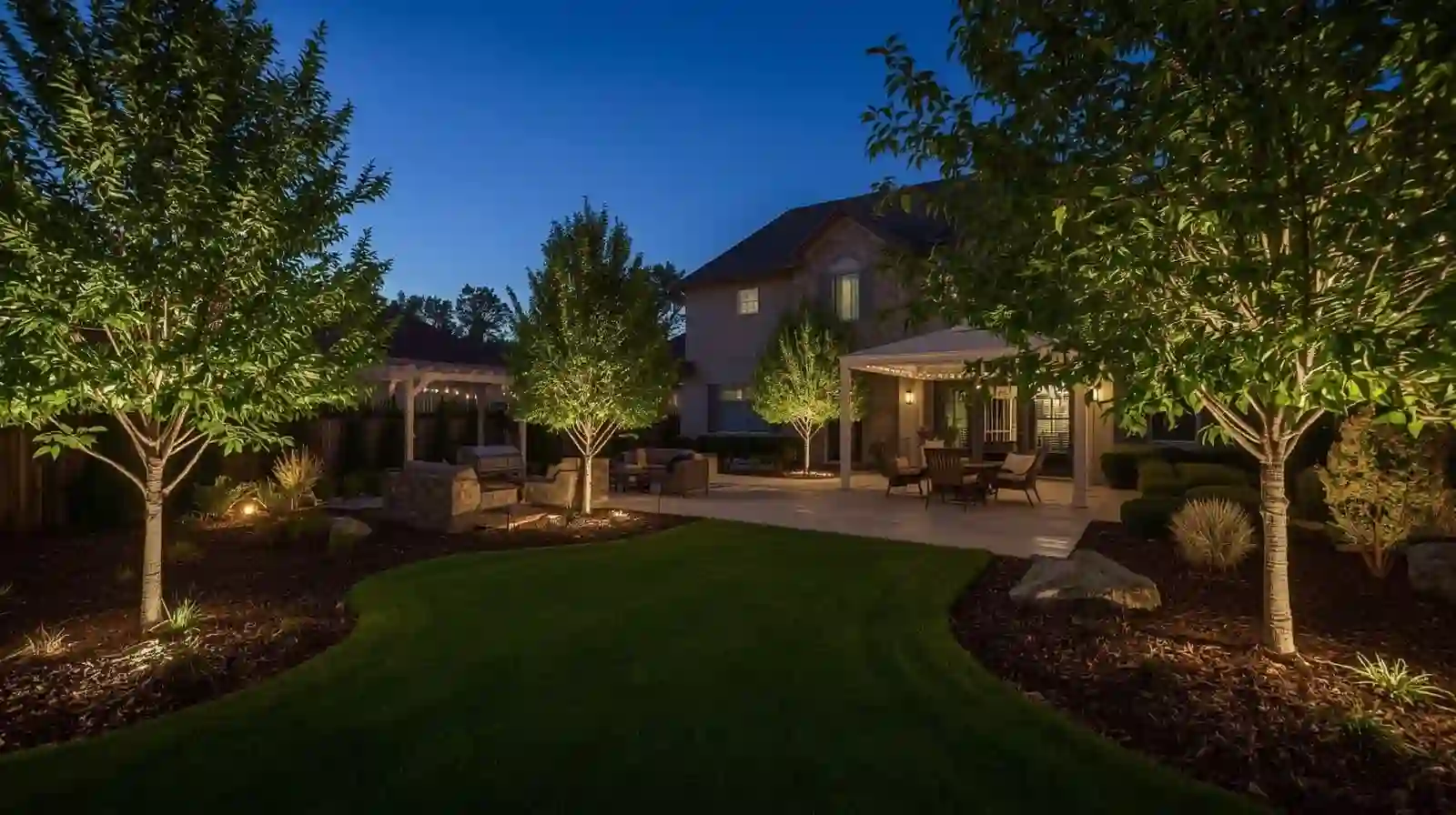
Most homeowners spend thousands of dollars on gorgeous gardens, patios, and outdoor spaces. Yet, they let them slip into the dark every night. That’s a big waste. If you’ve been putting off lighting your yard because you think it will be hard or cost a lot of money, here’s the truth: it doesn’t have to be either. When you learn how to design landscape lighting the right way, you get a yard that looks polished, feels safe, and actually works for your lifestyle.
You won’t have to guess because this guide takes you through every step, from picking the correct fittings to organising your layout. You’ll know exactly what to expect, what’s involved, and how to obtain the greatest results, whether you choose to do it all yourself or hire someone.
What Is Landscape Lighting?
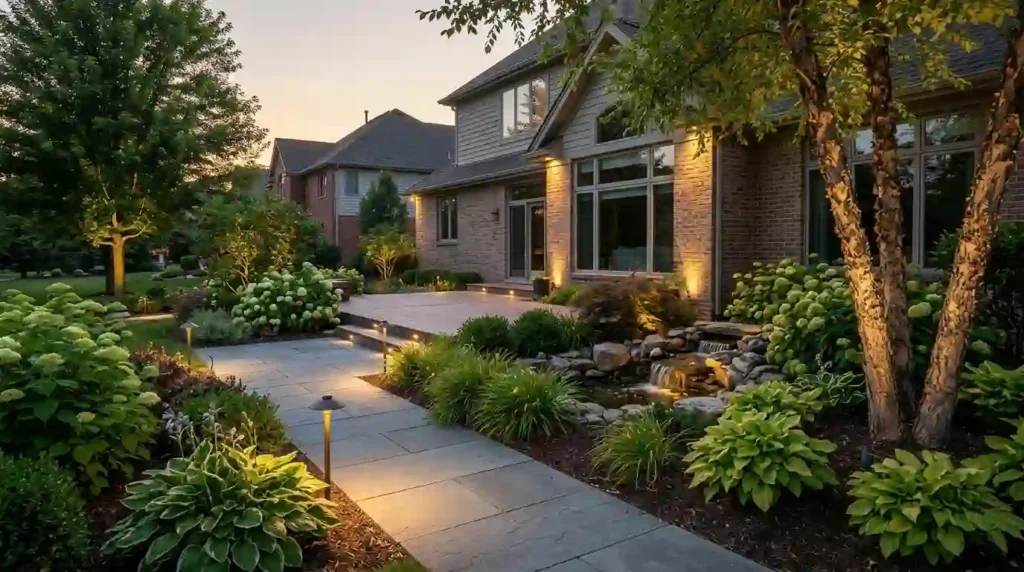
Landscape lighting is any planned system of outdoor lights placed around a property covering paths, trees, garden beds, patios, driveways, and architectural features. It’s not just decorative. Done right, it adds security, guides foot traffic safely at night, and extends the usable hours of your outdoor spaces.
The term covers everything from simple solar path lights to complex low-voltage wiring systems controlled by smart timers or apps. The key word is planned. Randomly placed lights almost always look worse than no lights at all.
The Importance of Your Landscape Lighting Plan
The most typical mistake is to not follow through with a plan. You get dark spots adjacent to blown-out brilliant regions, too many fixtures in one area and none in another, and a wiring tangle that is impossible to correct later if you don’t have one.
A solid guide for designing outdoor lighting is like a blueprint. It shows you where to put each fixture, what kind it is, and how to connect it to your power supply. That plan will save you money when you install it and a lot of trouble later on.
Think of it this way: a plan is the difference between a lighting system that looks intentional and one that looks like an afterthought.
Should You Learn How to Design Landscape Lighting or Leave It to the Professionals?
For most standard projects path lighting, uplighting trees, and accent lighting patios DIY is absolutely manageable. Low-voltage systems are safe, easy to install, and don’t require an electrician. If you need high-voltage wiring, in-ground conduit, or a complex multi-zone smart system, a professional is worth it.
Here’s a simple way to decide:
- Go DIY if: You have a straightforward layout, want to use low-voltage or solar fixtures, and are comfortable with basic outdoor work.
- Hire a pro if: Your project involves high-voltage wiring, large properties with multiple zones, or you want a fully automated smart system.
DIY landscape lighting design kits are widely available, cost-effective, and genuinely good now. Most come with a transformer, wire, connectors, and fixtures everything you need to get started.
How to Create a Landscape Lighting Installation Plan
This is the foundation of everything. Before buying a single bulb, walk your yard at night with a flashlight. Look for what’s already dark, what you want to highlight, and where safety lighting is needed.
Here’s a simple process that works:
Step 1 Sketch your yard. You don’t need a perfect drawing. A rough overhead map showing your house, garden beds, trees, walkways, and seating areas is enough.
Step 2 Mark your highlight points. These are features worth lighting: a specimen tree, a stone wall, a water feature, or the front entrance.
Step 3 Identify safety zones. Steps, dark pathways, driveways, and entry points all need functional lighting not just decorative.
Step 4 Choose your fixture types. Match the fixture to the job (more on this below).
Step 5: Plan your wiring route. For low-voltage systems, run wire from your transformer outward in a loop or spoke pattern. Keep wire runs under 100 feet per circuit where possible.
Step 6 Choose your transformer location. It should be near an outdoor GFCI outlet, ideally close to the main cluster of fixtures.
Step 7 Test before you bury anything. Lay out everything above ground first, check the effect at night, then finalize placement before digging.
Understanding Landscape Lighting: Techniques That Actually Work
Before picking fixtures, understand what each lighting technique does. These terms come up constantly in any outdoor lighting design guide.
Up-lighting: Fixtures on the ground pointing upward. Best for trees, architectural walls, and columns. Creates drama.
Down-lighting: Fixtures mounted high in trees or on roof eaves pointing downward. Mimics moonlight. Softer and more natural.
Path lighting: Low-mounted fixtures along walkways. Functional first, aesthetic second.
Grazing: A light placed very close to a surface like a stone wall to rake across it and show texture. Striking effect.
Silhouetting: A light placed behind a plant or object, against a plain wall. Creates a sharp dramatic outline.
Spread lighting: Wide, low fixtures that light ground cover, flower beds, or grass areas evenly.
Mixing two or three of these techniques in one yard creates the layered, professional look you see in high-end landscape lighting design ideas.
Types of Outdoor House Lighting
Choosing the wrong fixture for the job kills the effect. Here’s what each type is actually for:
Path lights Low-mounted, typically 12 to 18 inches tall. Use along walkways, driveway edges, and garden bed borders.
Spotlights Directional, focused beam. Use for trees, sculptures, and architectural features. Available in narrow and wide beam angles.
Flood lights Wide beam, high output. Use for large walls, driveways, or security coverage. Don’t overuse them.
Well lights Flush-mounted in the ground. Nearly invisible during the day. Great for up-lighting without visible fixtures.
Wall lights / sconces Mounted on fences or exterior walls. Good for patios, entry points, and outdoor dining areas.
String lights Decorative, warm ambiance. Perfect for pergolas, gazebos, and seating areas.
Step lights recessed into stair risers or retaining walls. A safety essential that also looks clean and modern.
Landscape Lighting Design Ideas Worth Trying
Here are a few approaches that consistently look good regardless of yard size or budget.
The Moonlighting Effect: Mount a few warm-white LED spotlights high in a large tree, angled downward through the branches. The dappled light on the ground below mimics natural moonlight. It’s one of the most-loved effects in residential landscape design.
Frame the Front Door: Use two symmetrical uplights or lantern-style wall sconces to frame your entrance. Simple, but it makes the house feel welcoming and finished.
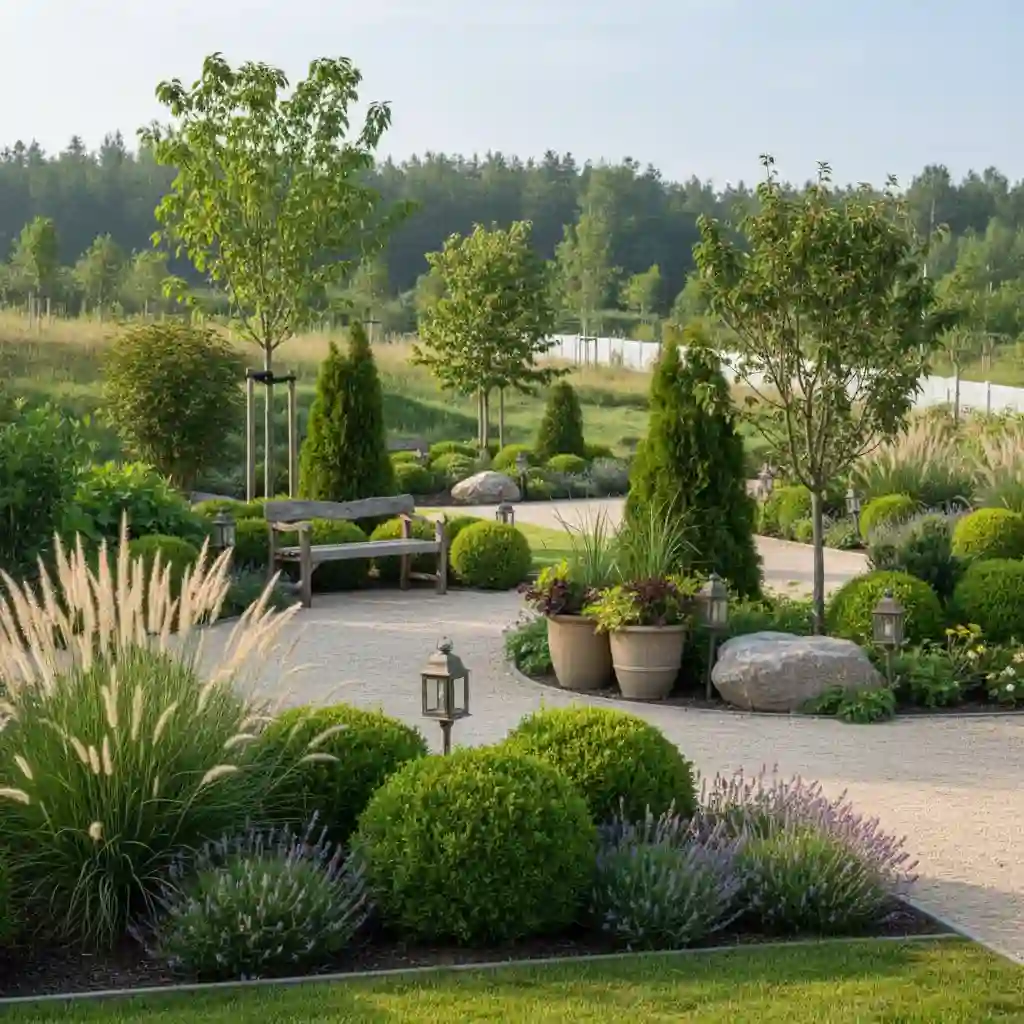
Layer the Backyard: Combine path lights along the perimeter, string lights above the patio, and a spotlight on a feature plant or tree. Three layers, three different heights — it reads as intentional and polished.
Highlight One Big Tree: Pick your best tree and light it from two or three angles with low-wattage spotlights. One well-lit focal point beats ten mediocre lights scattered everywhere.
Light the Water: If you have a fountain, pond, or pool, use submersible or waterproof fixtures to light it from below the waterline. The effect at night is genuinely striking.
Energy Efficiency and Smart Controls
This part is more important than most instructions say it is. If you leave old halogen bulbs on all night, your electricity cost will go up a lot. That worry is practically gone now that LED lights are available, but smart controls go even farther.
A simple timer makes sure the lights are only on when they need to be, which is usually from dusk until midnight. A photocell sensor turns on the lights when it becomes dark and off when it gets light. You can regulate zones, set brightness, and change the scheduling of smart transformers from your phone.
Path lights that run on solar power are quite handy in places with little traffic and lots of sun. Solar lights today can keep their charge even on cloudy days, and they don’t seem cheap anymore.
Maintenance: What People Always Forget
Good outdoor lighting design ideas mean nothing if the system falls apart in two seasons. Here’s what to stay on top of:
- Clean fixture lenses twice a year. Dirt and oxidation cut output noticeably.
- Replace bulbs as they dim, not just when they fail. Dimming LEDs often signal early failure.
- Check wire connections after hard winters or major rainstorms.
- Clear solar panel surfaces of leaves and debris monthly.
- Adjust fixture angles seasonally plants grow and block light paths over time.
Get Professional Help When You Need It
If you want a system that’s fully customized, multi-zone, and built to last working with a professional landscaping team makes sense. At Robert’s Complete Care, we design and install landscape lighting systems for homes across the area. Whether you need a simple path lighting setup or a complete outdoor lighting plan, our team handles it from start to finish.
If you’re in Southern California and want expert help with your outdoor space, check out our Landscape Design Whittier CA Service we’d be glad to help you build something worth seeing after dark.
Frequently Asked Questions
What are the six rules of landscape design?
The six core rules are unity, balance, proportion, focalization, rhythm, and simplicity. These apply to lighting too a well-lit yard uses consistent warm-white tones, balances bright focal points with softer fill lighting, and avoids cluttering every corner with fixtures.
What is the golden rule of lighting?
The golden rule is to layer your lighting: always combine ambient, task, and accent light sources. In outdoor spaces, that means general path lighting, functional step lighting, and focused accent lighting on plants or features.
What are the 7 steps to landscape design?
Assess your space, identify goals, sketch a layout, choose plant and hardscape materials, plan irrigation and lighting, set a budget, then install in phases. Lighting should be planned from the beginning even if it’s installed last.
How can I learn lighting design?
Start with free resources from the American Lighting Association, study real yard examples, and experiment with a small low-voltage kit before committing to a full system. Hands-on practice teaches more than theory.
What is the 3 lighting rule?
The 3 lighting rule says every space indoor or outdoor should have three types of light: ambient, task, and accent. In a backyard, that might be string lights overhead, path lights on walkways, and spotlights on a tree.